I watched, on my HDTV, some of what I'm going to call the pneumatic edition of "Prince of Wails" with Lanczos scaling it to 1080p. I compared it to the 540p pneumatic version (stretched to fill the TV) and... the Lanczos version has a slight edge. It's a little smoother and sharper where the 540p version has a faint blockiness (because of the stretch). I'm not sure the Lanczos version needs to be 3GB, however. I think setting the bitrate at 10 Mbps was too much.

It looks like an okay DVD whereas before pneumatic arrived on the scene, it looked like a faded VHS copy of a VHS copy.

Also, as pneumatic noted: the 24 fps frame rate makes the spiral of Earths in the opening titles appear to skip several frames. I'm going to see if I can switch it to 30 fps in Hybrid.

1,082

(934 replies, posted in Sliders Bboard)

There is a rumour about why DAREDEVIL on Disney+ will not feature Foggy and Karen: it takes place between INFINITY WAR and ENDGAME when Thanos had disappeared 50 percent of all life in the universe. This rumour was based on a location shoot with a church sign dated 2020, but fans and journalists later noted that this church sign was actually a real sign at a real church that had in real life not been updated.

However, I have to say: DAREDEVIL on Disney+ being set during the Blip would be a story worth telling and it would make sense if Foggy and Karen weren't in the show if this were the timeframe.

If 50 percent of the human race were erased, it's impossible that no one in Matt's social circle was affected. From a dramatic standpoint, the most story possibilities fall with the direction where Matt is the one to survive and now he has to live in a world without Foggy, without Karen, and one where Wilson Fisk could stroll out of jail and begin rebuilding his life as the Kingpin.

I hope this rumour is true because it's the first thing I've heard that would make me accept and embrace a DAREDEVIL without Karen and Foggy.

1,083

(1 replies, posted in Sliders Bboard)

Over in the DVD thread, RussianCabbie and I once considered that the 'best' way to watch Episodes 102 - 109 of SLIDERS might be to watch it on a CRT television or apply ffdshow filters (scanlines) to make the image look like a CRT display. I vaguely recall some April Fools jokes about THE X-FILES receiving a 'vintage' VHS release that would require a truck rental and a storage space to carry the complete series home.

On a tangent, one recent sitcom that I adored which got cancelled on a cliffhanger: BLOCKBUSTER, a Netflix half-hour comedy about a fictional Blockbuster and its staff trying to keep the store afloat. Critics loathed it, audiences were indifferent to it, I thought it was nice and inoffensive and charming but a bit short on ideas for how a Blockbuster could stay open in this day and age except as a sort of pioneer village equivalent of 90s video stores (which I think is how the actual Last Blockbuster in Bend, Oregon stays open).

The show had a season finale cliffhanger where an internet outage causes people to flock to the Blockbuster, but then a fight breaks out and the store is trashed. This melancholy setup for Season 2 unfortunately never got resolved. I wish Netflix had shot at least the Season 2 premiere that could either serve as the start to a new season or the end to the last one, but their algorithm (sigh) encourages cliffhangers so that viewers will feel compelled to watch something else on the service.

However, the cancellation spurred lots of jokes about how Netflix had killed Blockbuster for the second time.

I'm just happy that pneumatic's experimentation and explorations have yielded something I didn't think we could have: an acceptable DVD image from the Season 1 Universal DVDs.

Yes, the image still looks like a standard definition analog videotape from 1994 because that's what it is. But it's clear of jagged edges, it isn't obnoxiously distracting me with interlacing lines flashing across the screen, and at living room distance on an HDTV, it looks like an okay DVD.

I don't even think my new transcode to 1080p (with 3GB files per episode) is really even necessary; it just seems better to have the file brought to 1080p with a pixelation-reducing rescaler (Lanczos) rather than my TV doing a linear stretch.

I'm seeing the same issues even with 540p AI upscales. I don't know what AI algorithm is really right.

AI upscaling from SD to HD is operates best when analyzing the film grain and extrapolating from that to recreate an approximation of the original film image. That's how a fuzzy but grainy SD image can look great in AI-HD. It's is why Season 2 in its blocky graininess looks very good after an AI upscale. This is why the very grainy Seasons 4 - 5, even in hypercompressed Mill Creek discs, looks terrific after an AI upscale.

Season 3 doesn't really look that much better (and no worse); there isn't that much grain in the SD image, but there's enough SD detail for AI to sharpen, so a good image in SD looks good in AI-HD.

With Season 1 after the pilot, there's a lack of detail, some artifacts from the detelecining/deinterlacing, and a lack of film grain. The grain just didn't survive the film-to-analog videotape transfer. Without grain, AI will just inflate the existing lack of detail and artifacts with more pixel contrast and create bizarre and distracting anomalies.

I think I'm going to run through pneumatic's processing advice again, but this time output the file to 1080p with Lanczos scaling just to see how it looks.

I've had a look at "Fever" in progress of the AI upscale to 720p and... I do not like what I am seeing. The TIVTC + QTGMC transcode had its flaws like how the skin above the actors lips looks white instead of skin coloured. In the SD transcode file, the softness of the image means this flaw blends into the picture and at living room distance, it's a non-issue. But in the 720p upscale, that white line is enhanced and sharpened and you can't unsee it or look away from it.

I think pneumatic just getting a decent image out of these poorly handled DVD files for 102 - 109 was a huge achievement. I think I'll take until tonight to decide if I'm going to continue with this upscale or whether or not I'll just see about Topaz AI sharpening them up as 540p files (and hope that doesn't add more image flaws while offering few gains).

I've transcoded episodes 102 - 109 with TIVTC and QTGMC. I had a look at them earlier and pneumatic's recommendations have yielded much-improved files. The video quality has gone from severely aliased (DVD) or blurry (Handbrake-detelecined-DVD) to... soft. Soft focus, but watchable and adequate.

My suspicion is that this is probably the upper limit of video files sourced from late-1994 to early-1995 era analog videotape. Season 2's digital videotape episodes, while having a softness to them, were also covered in blocks and grain that an AI upscale could mine to rebuild a facsimile of the original film image.

With the Season 1 episodes, pneumatic's tips have avoided the blurriness that Handbrake created in decombing the files, but I don't see the Season 2 level of grain or the Season 3 level of sharpness needed to bring it to AI-generated 720p. The image is too soft, although better than what's on the disc.

However, I've still loaded everything into Topaz AI for a 720p upscale just to see what happens. My soul won't rest until we try. My expectation, however, is that it'd be best to just put the files in Topaz AI for 540p output so as to add a bit of AI sharpening and film grain but not add more pixels.

1,088

(759 replies, posted in Sliders Bboard)

I bought a set of $7 USD neckband earbuds. That seemed about right for such a dated form factor. They're the Rythflo Bluetooth Earbuds and... I'm reminded that neckband earbuds have some real advantages over true wireless earbuds like AirPods or the Jabra Elite line.

First, neckband earbuds sound fuller and richer with more bass. The Jabra Elite 75t and AirPods sound fine, but being small-sized devices, they never have the depth and bass of full fledged earbuds. They don't have the space for larger sound drivers since they need antennae and batteries. Neckband buds give volume to all the background noise of movies and TV that true wireless earbuds tend to leave out.

Second, neckband earbuds allow you to use your own choice in eartips. My memory foam eartips create a better seal to block out external noises which is preferable for a gym session when I don't want to hear other people around. Most true wireless earbuds need you to use the eartips that came with them in order to fit into the charging case. Neckband earbuds use a charging port. Admittedly, the Jabra Elite 75t comes with active noise cancellation, but ANC for me isn't going to be as effective as a tightly sealing eartip.

Third, have longer battery life. Yes, my Jabra Elite 75t can play for about five hours before it needs to go back in the charging case (which can charge the earbuds three times before needing a charge itself). But neckband earbuds using modern low power Bluetooth technology can last for 30 hours of use (unlike the 6 - 10 hours my old neckband earbuds had on Bluetooth 4.0). I can throw these neckband buds into my gym bag and only recharge them every few weeks.

I was surprised that this cheap neckband set had multipoint pairing (connecting to two devices at the same time), but they have it.

The only thing about these neckband earbuds that disappoint: the microphone is rather crackly. I left myself a voicemail to check the microphone and my voice was a bit staticky.

But I that's okay. I don't think I would ever wear my neckband earbuds outside of the gym; I don't feel safe walking the streets without at least one ear open to the world. I prefer the same when making phone calls. But this $7 purchase is great for the gym.

pneumatic wrote:

If you want a noisier but higher resolution image, go for TIVTC (I'm then adding a bit of sharpening through my media player's renderer).

Thanks so much. Strangely, my use of the QTGMC filter alone isn't removing the jagged edges. I think I'm doing something wrong in Hybrid.

But TIVTC is what I'd prefer: I want all the noise because that's the raw material for a Topaz AI upscale. I'm also going to follow your lead and use CPU encoding so that I can set the tuner to "grain" to get whatever little film grain texture is in these files. I've set the encode to run a "very slow" two pass job, so it's going to take 12 - 13 hours to process episodes 1.02 - 1.09. Hopefully, these Universal DVD files will become in the best possible shape they can be for upscaling afterwards.

While I've only ever seen the first two episodes of QL1.0, I understand from REWATCH PODCAST that Deborah Pratt as the voice of Ziggy is a cultural touchstone, a critical pillar of the QUANTUM LEAP iconography akin to MacGyver with his paper clip, Batman with his batarang, Spider-Man with his webbing, Xena the Warrior Princess with her chakram, and the Doctor with his police box.

I wonder why they haven't had Pratt do the voice. She is working on the show as a producer. Has her voice aged too much? Or do they want Ziggy to be gender-neutral for 2023?

Thanks. As a follow up: if I went with purely QTGMC, what settings would you recommend?

https://i.ibb.co/B4cXkF6/qtgmc.jpg

The Bob option boosts the framerate to 60fps; do you recommend that or would you stick to 30?

Or is the TIVTC with QTGMC combination your recommendation?

Also, for the encoder container: I'm using NVEnc to take advantage of nVidia hardware acceleration. What settings would you recommend for the best quality?

https://i.ibb.co/qW8QPF0/hybrid2.jpg

And what settings do you recommend for the Crop/Resize to avoid losing resolution?

https://i.ibb.co/zrRFvH3/hybrid3.jpg

Since the Universal files don't have much image detail to lose, I want to get the best I can out of these files to see what Topaz AI can do with them. My main concern: I don't want to lose any film grain (assuming these files have any) because AI upscaling is dependent on grain for rebuilding the image.

Another question: why output the files to 720x540 instead of 640x480? Which one is the 'native' resolution of the DVD files?

Thanks. I did switch to Avisynth over Vapoursynth. For some reason the VidDetect settings are greyed out.

https://i.ibb.co/RT6RSYh/hybrid1.jpg ||https://i.ibb.co/cgP1wck/hybrid2.jpg

On my (low end) gaming laptop, Hybrid is estimating about seven minutes per episode encode, so there's a lot of room for experimentation.

I played "Fever" just now on my 55 inc TV. "Fever" has looked ghastly when played from the Universal DVD. Jagged edges, dull details. But this QTGMC version looks clean and reasonable. Long shots still lack detail, but they don't seem as blurrily smeared or jaggedly pixelated as they did before. The video quality has gone from terrible to reasonably okay, although still a step down from the more detailed digital videotape look of Season 2 or the crisper look of Season 3 or the crystalline definition of Seasons 4 - 5.

The QTGMC encodes are pretty enjoyable to watch on a modern HDTV. I'm now curious about upscaling these files to 720p in Topaz once I redo all the encodes with pneumatic's settings. I might even try outputting the QTGMC file to 720p and letting Topaz AI run on it without adding more pixels just to see what happens.

Hybrid and QTGMC has done a pretty good job of smoothing out the 'jaggies' in "Fever". Those shelves in the pharmacy now look smooth. But I'm wondering if I'm using the best settings. I'd like pneumatic's opinion.

https://i.ibb.co/BKQPkZG/hybrid.jpg

Can pneumatic tell me what settings to use for QTGMC in Hybrid? I'm still getting the jagged edges in "Fever" on the pharmacy shelves that Handbrake detelecine smooths out. I think I need some direction.

Hybrid can be downloaded here:
https://www.videohelp.com/software/Hybrid

It's possible I just need to learn how to use Avisynth.

https://i.ibb.co/WFgJd7k/hybrid.jpg

EDIT
Looks like I wasn't using the Hybrid-Avisynth settings. Found some instructions. Running the job again.
https://forum.videohelp.com/threads/401 … ost2619089

pneumatic's result with "Princes of Wails" is vastly superior to anything Topaz has done with Universal's Season 1 (aside from the pilot). Topaz made 1.02 - 1.09 look like a muddy, watercoloury mess. However, to rip the DVDs, I copied them with MakeMKV, then decombed-deinterlaced the MKVs in Handbrake. QTGMC seems superior.

Topaz can't upscale the MKV file without decombing and deinterlacing; comb lines and jagged edges keep appearing across the image. Even Topaz's deinterlacer can't address it.

I'm not sure why QTGMC results look so much better than Handbrake's decomb. Maybe pneumatic can explain that.

Once my XENA upscales are done by tomorrow, I'm going to follow pneumatic's lead. I'll use MakeMKV to re-copy the Universal discs for 1.02 - 1.09 and use Hybrid and QTGMC to deinterlace the rips to MP4 and then see if Topaz can do better with this process.

1,097

(34 replies, posted in Sliders Bboard)

pneumatic wrote:
RussianCabbie_Lotteryfan wrote:

Question.  What would Quinn's age be today vs. the age of Arturo in the pilot?

I'd imagine ireactions can give the best answer here, but I'd guess Quinn is supposed to be in his mid 20's and the professor in his 50s?   Under this assmption, 2023 Quinn would be approximately the same age as 1995 Arturo.

It makes me nervous that you think I would give the "best" answer. I can only give you *my* answer. Please note that my head canon is not actual SLIDERS canon.

Tracy Torme's original intention was that in 1994, Quinn Mallory is 22 years old, born in 1971 or 1972, so Quinn is 50 - 51 years old today. Quinn's age is given as 22 in the original draft of the Pilot script. Jerry O'Connell was born in 1974 and was 20 when he first played Quinn. However, the second draft and the shooting script declare that Quinn is 25, born in 1968 pr 1969.

This was probably to widen the range of twentysomething actors. Quinn's in grad school, so he's completed his undergraduate and is at least 22; Quinn is said to be two semesters (so less than eight months) away from graduating. The Berkeley graduate degree in physics takes two semesters to earn (at least in 2023), so Quinn's scripted age of 25 strikes me more as a casting note than a serious story point.

And yet, in my personal opinion, Quinn is actually Jerry O'Connell's age in the Pilot -- 20 years old. I go with 20 because Torme says in "The Guardian" that Quinn skipped two grades, so that would make him 20 years old when he finished his undergraduate and started on his graduate program. Quinn would be 49 today and I consider the Professor the same age as John Rhys-Davies (born in 1944), so Arturo was 50 in 1994.

That said, I don't know how long the graduate program for Berkeley was in 1994 and if the shooting script said that Quinn was 25, there could be any number of props and onscreen documents that maintain that.

I really liked this movie. Thank you to QuinnSlidr for recommending it. I really enjoyed a female Asian senior citizen citizen as the lead character of a fantasy epic with dialogue alternating between English, Mandarin and Cantonese. The movie is clearly on a low budget and staged across two main indoor locations (the laundromat and the IRS office), but it uses those two spaces for a wide range of psychological states for Evelyn's character.

Michelle Yeoh's Evelyn is highly compelling. The wonky, silly, goofy, threatening, dangerous tone of the film as Evelyn learns about her situation is hypnotic. Ke Huy Quan is incredible in shifting between different versions of the Waymond character.

As a multiverse story, this film doesn't have too much bearing on SLIDERS. It's not about alternate histories leading to a bizarre inversion of the present day like "The Weaker Sex" or "Eggheads". The alternate realities are defined in how they have different circumstances for Evelyn: she's a ninja, an actress, a businesswoman, a doctor, a janitor and Waymond has a beautiful line about how Evelyn's failed at so many things that she has created tremendous potential across all her realities for anything.

Evelyn has a hilariously petty moment where, when she first learns about the multiverse, her immediate desire is to tell her husband how in every parallel world, she's better off without him.

That said, two hours is a bit much to spend in the laundromat and the IRS office. This would probably have benefitted from being episodes in their separate parts watched on successive nights.

THE REWATCH PODCAST reviewed episodes 5 - 6 of QUANTUM LEAP 2.0.
https://therewatchpodcast.blogspot.com/ … 05-06.html

They don't think that the plotline of Ben trying to connect with his mother was part of the original Episode 6 back when it was meant to be Episode 1. Yes, the plotline mirrors the original premiere of the 1989 QUANTUM LEAP. But Tom and Cory note: QL2.0 starts with Ben's memory having been erased. He doesn't know who he is. He doesn't know who Addison is. The later episodes are scripted around Addison deliberately avoiding any triggers for Ben's memory. Would Ben even remember anything about his mother in the original QL2.0 pilot?

Tom also presented my theory and then Temporal Flux's theory for why QL2.0 has no Waiting Room. https://sliders.tv/bboard/viewtopic.php … 888#p13888

My theory was written to assist Tom and written before I had actually seen the show and I was just filibustering with technobabble. I was impressed and horrified by how Tom in the podcast reads out my theory and demonstrates a shocking gift for delivering my unreadable, unsayable paragraphs of convoluted impenetrability. Tom offers Temporal Flux's theory after mine and TF's theory is actually fit for human consumption.

Anyway. I had to take a break from QL2.0 to enjoy the epic EVERYTHING EVERYWHERE ALL AT ONCE over a few days, but I am getting back into QL2.0 tomorrow!

1,100

(759 replies, posted in Sliders Bboard)

Back in 2016, wireless earbuds were all the rage. People who hated wearing headphones with cables tethering to their pocket radios/MP3 players/phones had lived lives devoid of music or podcasts or radio. Then suddenly, there were wireless earbuds: 6 inch plastic bands that hung around your neck with the sound-emitting buds extending up to your ears. Your head no longer had to be tethered to your phone. Without wireless neckband earbuds, I would never have become so enthusiastic about THE REWATCH PODCAST with Tom and Cory.

Wireless neckband earbuds were a go-to gift for several Christmases. My favourite neckband earbuds were Skullcandy which were very affordable and had a very bass heavy sound design that was great for such small sound drivers. Of course, even in 2016, Skullcandy's neckband designs were being made somewhat obsolete as Apple released the first generation of its AirPods.

AirPods had Bluetooth earbud technology miniaturized with a more power efficient design that no neckband was needed: all the hardware could fit into each bud. But Airpods went for $160 USD for one set and had an 'open' design that let outside sounds in while whereas the Skullcandy Ink'd neckband cost $50 USD and you could replace the tips on the earbuds with any size that would fit and and seal it to your ear. Neckband earbuds (Skullcandy or not) were the better choice.

In 2018, Jabra had released a competitor: the Jabra Elite 65t "true wireless earbuds" which, like the AirPods, had all the technology in the individual buds, eartips that sealed to the ears, but these things cost $190 USD, even more than the $160 AirPods. However, in 2019, the the Jabra Elite 65t could be found discounted or open box for $40 USD and I found myself intensely tempted by the idea of being able to listen to a podcast in only one ear while outside and having the other ear free to catch any noise.

My lightly used Jabra 65t set started glitching after 18 months, randomly losing connection and not charging, but I was so enamoured with the form factor that I replaced it with the Jabra Elite 75t (which I bought lightly used for $40) in 2020 and these have lasted right up to today. I liked it so much that I bought another lightly used set: one to keep in my bag when out, one to keep at home for use. And my neckband earbuds?

I don't know. Recently, as I was getting back into the gym, I thought it'd be good to keep one set of wireless earbuds in my gym bag, exclusively for gym usage. I searched for my old neckband earbuds. They were nowhere to be found. I looked to see if neckband earbuds might still be sold in shops and expected that the prices would be very low since true wireless earbuds had made them a dated product. But neckband earbuds simply weren't to be found. And online, the Skullcandy neckband earbuds on sale are at absurd prices for being 'vintage'. These things aren't worth the price of $50 USD. They aren't even worth $20 USD.

I see a local eBay retailer selling what looks to me like Beats neckband earbuds that a factory in China is still making but without the branding, possibly to use up remaining component supply. They're going for $12 USD which is probably what these are worth now... assuming these even work. The era of neckband earbuds is over even as a cheap option for isolated use cases.

I'm still kind of curious about this $12 neckband set.

This movie is so big I am having to watch it over the course of several days like a mini series rather than a movie.

There used to be a Topaz page where you could download old versions, and I downloaded an older build of Topaz that I've reinstalled. They seem to have now taken all the old versions of the video upscaler, however.

I've been AI upscaling episodes 1.02 - 1.09 of SLIDERS. No increase in resolution, just adding graininess to the 480 image to fill in the blurriness. It looks passably okay on my 55 inch HDTV at living room distance, but it's very grainy and staticy. I think a part of the staticy look: the latest Topaz AI has a minimum grain size setting (1 on a scale of 1 - 15) and no longer lets me reduce the grain to 0.1 - 0.9 on their scale. All the grains are way too big, distracting rom the image instead of giving the impression that the image is composed of the grain. I think, once I finish my XENA cleanup on the first season (removing the blocky digital videotape distortion), I'll take another run at SLIDERS 1.02 - 1.09 with the older version of Topaz and set a finer grain level.

SCREAM is an interesting example of a reboot/revival and SLIDERS might be able to learn something from it. The original SCREAM film in 1996 subverted teen slasher horror movies by featuring characters who'd watched slasher movies, knew all the tropes of the formula and would comment on them between fleeing getting knifed to death. It was a cultural sensation for its witty dialogue and the way it turned all the horror cliches on their heads.

Its $15 million budget earned $173 million at box office, 11 times its budget. A film needs to earn three times its budget to turn a profit, so this was a small investment for an excellent return. Naturally, a sequel was in theatres a year later with SCREAM II (1997) with a bigger budget ($24 million), bigger setpieces, Jerry O'Connell on break from SLIDERS, a very rushed scripting and shooting production that led to some sloppiness and urgent rewrites -- and it made $172 million.

While still a terrific return on investment (seven times the budget), the series had not grown its audience. The studio hurried into a third film, but it couldn't move as fast as before: cast contracts had to be redone, a school shooting made the studio hesitant to make as bloody a film as before, the original star (Neve Campbell) was unavailable, the original screenwriter wasn't willing to write a less violent sequel and had to be replaced.

Campbell eventually signed on but only for 20 days of filming, a new writer hacked out a draft, SCREAM III hit the cineplex in 2000 and... its $40 million budget saw $162 million. It made back four times its budget, so it turned a small profit, but SCREAM had clearly had its day: the budgets from rising cast salaries had made it difficult for a SCREAM film to turn a great profit again.

Eleven years later, the studio thought enough time had passed for nostalgia to bring in ticket sales again and commissioned a fourth film on a $40 million budget. With inflation, SCREAM IV was actually being made for about 25 percent less than SCREAM III. SCREAM IV would have to earn $120 million at box office to enter profitability; if it could make it to $200 - $250 million, SCREAM IV would be as worthwhile as SCREAM II. The studio was able to get the original actors back at reasonable rates as nobody had become Tom Cruise since 2000 despite working steadily.

SCREAM IV had the original screenwriter back who turned in a script with a cliffhanger ending to lead into a fifth film. The studio greenlit it... but abruptly backtracked in preproduction and mandated rewrites from another writer to make it a standalone film. The rewrites led to an incoherent, awkwardly plotted film that seemed to be introducing a new generation of SCREAM characters only to kill them off and negate the movie's own purpose. The film only made $90 million at box office, not even twice the budget. SCREAM IV was a loss and the series seemed to stop dead in 2011.

SCREAM came back in 2022 with a new movie that this time had the benefit of being coherent. The original screenwriter produced and gave guidance to a new team of writers and directors who this time committed to bringing in a new cast (although the originals still had small roles).

SCREAM V was made for $24 million -- effectively less than half of the SCREAM IV budget with inflation and less than the budget of the first movie. The budget was low with a tight shoot, a short shooting schedule, limited shooting days for the original actors (as they were expensive). SCREAM V was a success, making almost six times its budget at $139 million. Adjusted for inflation, this was $106 million in 2011 dollars, not much more than what SCREAM IV had brought in. But the budget was suited to the ticket and streaming sales. There was a solid economic argument to making SCREAM levels at this financial level.

That and positive reaction led to SCREAM VI in 2023 with a $35 million budget that looks to be on track to earn at least six times its budget back again. The low production rates, however, saw original star Neve Campbell receive an offer that she considered insulting and that she refused to take.

SCREAM VI was the first film in the series where Campbell didn't appear. Given how Campbell's appearance in SCREAM V was welcome but a bit tokenistic, however, it seemed fine that she wasn't in SCREAM VI.

The case for a reboot, in this instance, was that new SCREAM movies could be made cheaply enough that modest box office earnings would still offer a high return. That's  been the argument behind most long-running horror franchises; even if FRIDAY THE 13th and HALLOWEEN movies are bad, they cost so little to make that they easily  become profitable.

Can SLIDERS be as cheap as SCREAM V and SCREAM VI? (Scaled to TV, of course.)

1,105

(1,683 replies, posted in Sliders Bboard)

How would "The Button" have been rewritten for the Arrowverse? Would "Flashpoint" have featured Barry encountering a version of Robert Queen who had become the Hood while Oliver died? The way Thomas Wayne became Batman in the FLASHPOINT comic book story after Bruce and Martha died in this alternate timeline? Would Robert Queen have sought to reverse time, give Barry a letter to give to Oliver? Would "The Button" have steered into a crossover with THE FLASH and the WATCHMEN TV show?

... I wonder.

**

I watched THE FLASH 9.06, "The Good, The Bad and the Lucky" and as a viewer, I have to wonder why this story was more important than rescuing the Legends. Eric Wallace said that 13 episodes was not enough for him to focus on characters who weren't leads on THE FLASH. But this is a filler storyline because Grant Gustin seems to have only worked one day on this episode: Barry's at the beginning and at the end.

As someone who has some understanding of television, I understand why Eric Wallace told this story. Grant Gustin has been a on a downward spiral of exhaustion since Season 5. This is why the show has brought in more characters and deemphasized the Flash; it lets Grant Gustin work a little less. And for the final season of THE FLASH, Wallace felt that there should be one episode where Danielle Nicolet (Cecile) and Kayla Compton (Allegra) received near-exclusive focus if only so they could have something for their reels when they seek their next job.

Wallace also wanted to bring back the Becky Sharpe character because he clearly disliked how this sad woman was murdered for her luck powers in Season 5 and liked actress Sugar Lynn Beard, so he used the CRISIS time shift to justify her resurrection and gave her a new story and a happy ending.

I understand all that, but as a viewer, this is a really dull and pointless episode. Cecile has a moment of angst and gets a sappy motivational speech to get out of a rut and do what she was going to regardless. It's almost as though the beat sheet simply had a placeholder page that read: Cecile can't get it together for Reason for Emotional Paralysis To Be Added.

Cecile's angst is over being a mother, except... Cecile being a mother in no way informs any of her character decisions on the show. She isn't driven by a desire to take care of people or to train the inexperienced or to anticipate people's challenges. The story is about Cecile and Allegra finding the MacGuffin that's causing poor Becky Sharpe's problems; Cecile being a mother is just conversational filler. Becky Sharpe never gets a moment where she comes into her own power and seizes her destiny; the plot just happens around her.

The story doesn't have anything to say about luck, either. The story is simply about giving Grant Gustin a break and giving Nicolet and Compton some attention to make the actors happy.

I don't dislike Eric Wallace at all as a person, but his stories are very weak. And I would much rather have seen the Legends this week instead of Cecile and Allegra. At the same time, I understand why Eric Wallace would refuse to do that and instead devote the hour to two of his regulars and give them some moments in the sun. (It's a rather dim, flickery sun.)

1,106

(194 replies, posted in Sliders Bboard)

Every time I log into Dall-E or ChatGPT to get a sense of how to use these tools conscientiously and effectively, I just get error messages.

Lego_Sliders wrote:

What makes this worse is that your being nice to me? Makes no sense. You should be pissed off.


This is a very interesting question. The answer is in this thread title. This thread opened on March 4, 2021. Two years later, it has 535 replies and it will have more to come. Why is that? Because this thread represents a universal human longing for a second chance.

What happened to you with your first chance? I don't know. I don't know your story. But what would be the point of me verbally assailing you? QuinnSlidr seems to have that covered. Did QuinnSlidr make you reconsider your attitude to transgender identity? Or did it just put you on the defensive?

I don't know what drove to you consider it "hate and vitriol" when I reviewed an episode of QUANTUM LEAP and said that transgender rights are human rights.

Maybe you grew up in an environment where authority figures spoke derisively of gender-nonconformity and you've internalized that as a societal norm and because of that bad influence, you unravel when that norm is identified as a prejudice.

Maybe you weren't trained by parents and teachers for exposure to people with differing belief systems and practices that have no direct impact on you; they didn't prepare you to manage social shock, and so you react with fear and accusation that you regret.

Maybe you've been sexually assaulted and you associate non-heterosexual and non-genderconforming individuals with deviant perpetrators of sexual violence because you've been traumatized.

Maybe you've suffered rejection and felt powerless and clung to gender identity (and who knows what else) to feel value, and your instinct is that deriding other identities will give you a (false) sense of power.

Maybe at some point in your past, you were in a troubled and vulnerable state and received no sympathy, no understanding, no empathy, but were instead met with derision and anger -- and now that's how you react to certain concepts of identity that make you think of deeply disturbing memories.

Maybe you've had some other experience entirely that is too mundane and straightforward for me to imagine.

Maybe whatever happened to you was neither mundane nor straightforward but some ghastly and horrific event or sequence of events that you haven't even begun to process.

Maybe what you said isn't who you really are and you said what you did because you've been triggered and you're upset and you're not thinking clearly and you're in pain.

Maybe you just need some sympathy and understanding and a chance to change course.

Or maybe nothing happened to you. I don't know everything inside you, I don't know your life. But people don't set aside prejudices when they feel under attack; they cling to them more tightly because it's their security blanket and the way they feel they can put the world in order.

However, they may set them aside if they're asked to treat others better and given some assurance that the new behaviour they're asked to give is also what they'll receive.

Is there anyone reading this who wouldn't like a chance to start over with the benefit of what they know today?

Every SLIDERS fan knows what it's like to regret how things went and wish that they had done things differently. Every fan of SLIDERS wishes that they could redo the last five seasons of life with better script editing, tighter continuity, stronger performances, healthier relationships, fewer dead actors, lower cost overruns, more location filming, and a wholehearted commitment to treating others well. Who here would deny you -- or themselves -- the opportunity to start over and do better?

Who here wouldn't ask for a reboot?

The pattern on MAD ABOUT YOU looks like what I'm seeing on XENA and SLIDERS. I don't really recognize the RUGRATS pattern.

My understanding is that animation cels would be positioned in frame stacks to be filmed with a rostrum camera to record each frame, putting the combined cel images onto 35mm film and then spliced into a reel. I imagine that, for television, the film would be transferred to videotape for TV broadcast.

I've spoken to you as a friend, now I'm speaking to you as a moderator: if you want to keep posting here, there can be no further transphobia in your posts. No slurs, no claims that transgender rights advocacy is "forced education" or akin to mass murder, not even the veiled remarks from before. Transgender fans of SLIDERS (and I know of at least three with accounts here) have the right to be here without seeing themselves, their community and their rights attacked in any way for what are personal choices in how they address their own mental health and self-image and bodies, choices that do not physically or practically affect anyone but themselves. We mustn't hurt people for that. We can't treat people that way here. We have to be better than that. We have to be kinder than that.

Okay. I was going to catch up with Marvel on Friday night, but I'll watch this instead.

1,111

(3,555 replies, posted in Sliders Bboard)

From the Reboots thread:

QuinnSlidr wrote:

This world needs to stop the rallying cry of the white male base to attack something that doesn't need to be attacked. Everyone's identity should be respected without fear of reprisal or anything else that goes along with that. Sadly, the Rupert Murdoch media empire thrives on the hatred of white males, and uses it as a galvanizing tactic to further its agenda. And sadly, republicans have made white supremacists their base, for better or worse in this country. Sadly, it's worse.

And sadly, the election of the worst President in U.S. History, Donald J. Trump (Hitler), reinforced to these Nazis that it is okay for them to be bigots, a**holes, and terrible people. Where would we be if Hillary Clinton had been elected like we deserved instead of the electoral college cheating us out of her? She won the popular vote. Sigh.

One can only hope that his re-election does not happen in a similar vein to when Hitler was re-elected. Hopefully, his 20-30 years in prison for masterminding a violent insurrection will come sooner rather than later. Sometimes I wish I was in Hillary Clinton universe. Perhaps that universe never got covid and never had to experience falling victim to Q-Anon and the right wing extremists. Perhaps that universe never heard of Donald Trump (Hitler). Perhaps that universe is thriving and far more progressive. Sigh.

Hillary Clinton is no saint. I would say that even with a President Clinton, the United States might still be seeing the erosion of the victories of the civil rights movement. Deepening economic inequality. The mainstreaming of white supremacy. The emboldening of neo-Nazi values co-opting conservatism. I'm not saying Trump wasn't bad; I'm noting that it's not actually up to a US president to determine how transformative or competent their governance will be. Gerrymandering can leave a US president with as much power as the Queen of England; Clinton could have easily won a weak majority or even no majority in the House and the Senate.

President Clinton may have been a less-frightening face on a bad system, but it'd still be a bad system. Biden's inauguration didn't defeat extreme alt-right neo-Nazi conservatism. I would say that Trump put all those problems into focus, albeit by ratcheting them up to extremes and emboldening the fascist, racist, bigoted aspects of America to stop guising itself in family values and traditionalism. But that white supremacy was always present; it just hid better before Trump.

The damage Trump caused to America's social values and societal infrastructure is horrific, but I suspect it would have simply happened at a slower rate under President Clinton. Even with a President Biden in office, we're still seeing basic health measures like vaccines politicized when America welcomed vaccination for mumps and measles without question until the alt-right got into it. (In a painfully ironic twist, Trump is pro-vaccine.)

Even with a President Biden, gerrymandering and manipulation of the Supreme Court has made minority rule easier for Republicans. The Biden presidency doesn't have a lot of power and is very weak.

I wonder if the world where Hillary Clinton won might not be that different from the world we live in now. We'd still be facing a lot of the same problems. Slider_Quinn21 was against Trump, thinks Hillary Clinton would have dragged America into a crazy war with Russia, and I'm not sure he was wrong.

I suspect that in both worlds, we'd still have QUANTUM LEAP feeling like it has to teach people that transphobia is bad. I cannot stress enough in the name of Quinn's sneakers, the Professor's dress shoes, Rembrandt's loafers and Wade's boots that the views of ireactions are not the consensus of Sliders.tv P.S. transgender rights are human rights.

QuinnSlidr wrote:

The words of a Trumper: always calling the other side "hatred" for not tolerating their own transphobic, racist, and anti-semitic views. What about your intolerance of other groups of people based on their sexual orientation?

When we say "Trumper", I think of someone who is racist, anti-semitic, homophobic and engages in anti-vaccine pandemic denialism. In reviewing Lego_Sliders's post history, I have not seen racism, anti-semitism, homophobia or vaccine misinformation. I feel gratitude and appreciation to Lego_Sliders for cautioning me about signing up for an experimental sixth dose of COVID-19 vaccine (that got shut down).

Unfortunately, looking at the post history, I see what looks like transphobia and it fills me with grief.

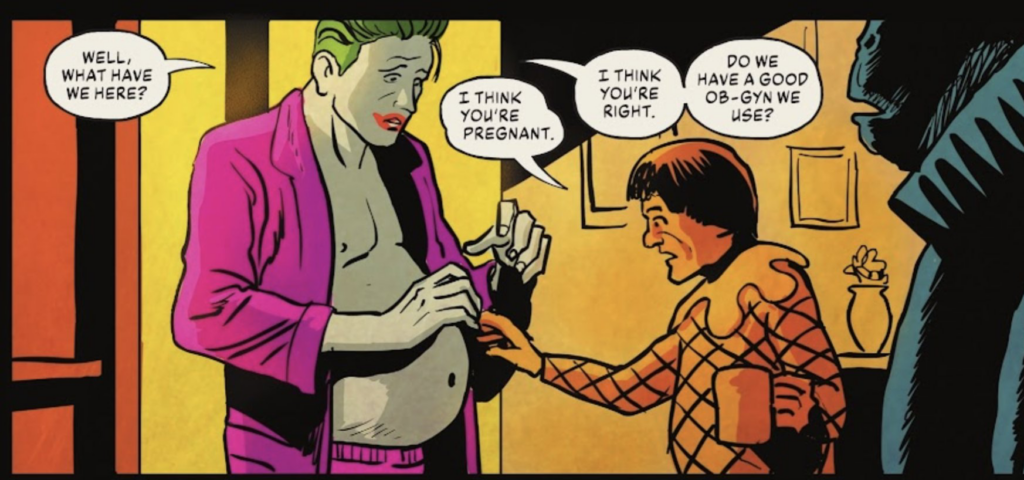
There's this post where Lego_Sliders posted a panel of a JOKER comic where the Joker is pregnant:

Lego_Sliders wrote:

We really are living in clown world:
https://arkhavencomics.com/wp-content/uploads/2023/01/image-5-1024x480.png

On its own, that might have been commenting on the biological absurdity (which we could also say of Rembrandt being pregnant in "The Prince of Slides").

But then we have this post where Lego_Sliders uses a transphobic slur:

Lego_Sliders wrote:

Didn't season 5 of sliders have a tranny episode? 'To catch a slider'

"Tranny" is a derogatory pejorative for transgender individuals, specifically to attack and deride people for their gender identities. Could it be an accident? People here misgendered supervillain Ezra Miller without any malevolence. Sometimes, we're not aware that common parlance has become offensive.

As moderator, I edited the quoted post to apologize for the use of this slur from a poster and I apologize again. Hate speech is not permitted here.

Then we have this over my QUANTUM LEAP 1.12 review where I called it overwritten but said that its message was necessary yet "overstated":

Lego_Sliders wrote:

Such hate and vitriol. Never would have expected ireactions to call for forced education. That is a a tactic out of Stalin's playbook. Ask yourself why you always hear the name 'Hitler' and never hear the names of Stalin (13 million dead), and Mao Zedong(11 million dead).

It's an absurd leap of non-logic to declare that 24 million people will die because I said transgender people have human rights.

I don't mind when people insult me or my writing, opinions or analytical style. People are welcome to do it. There's this special episode of REWATCH PODCAST where Tom and Cory call out all the plotholes and errors in my fanfic. They're reading a script; I wrote that script.

But this has gone beyond attacking me personally. The broadcast of an anti-transphobia episode of television that nobody has to watch is not "forced education". A review of that episode is not "forced education". Furthermore, the review being cited expresses (joking) 'hate' and vitriol towards an overly lecturing writing style for scripted conversations and calls that style dated and out of touch.

It's downright odd that someone would be offended by me saying that society needs to learn that transgendered individuals should have human rights, to accuse me of calling for "forced education". People are educated to learn that assault is wrong, that theft is wrong, that talking in a movie theatre is wrong, that stealing someone's Lego is wrong. Lego_Sliders would never call that "forced education".

So what we have here: offense towards a comedic drawing of a pregnant man; the use of a transphobic slur; calling respect for transgender identity to be "forced education".

In totality, all of the above examples demonstrate a focused and extreme anger towards transgender individuals having human rights. A level of anger that overrides sense and reason. There doesn't seem to be any other motive for why my decidedly mixed review of the anti-transphobia episode of QUANTUM LEAP would prompt this mania:

Lego_Sliders wrote:

Such hate and vitriol. Never would have expected ireactions to call for forced education. That is a a tactic out of Stalin's playbook. Ask yourself why you always hear the name 'Hitler' and never hear the names of Stalin (13 million dead), and Mao Zedong(11 million dead).

I'm going to dismiss your insults towards me. Even the very best of friends will say the wrong things at the wrong times. But I can't dismiss transphobia.

Now, I don't fully grasp transgender identity and community. Those are life experiences I will never have. But I don't need to understand someone's personal identity to respect it so long as that identity isn't based in transphobia or bigotry towards how people were born. No one was born a fascist.

I don't know what you got away with before you came here, but this is Sliders.TV. Thinly-veiled or unveiled, Lego or no Lego, transphobia has no place here.

As someone who appreciates you, I am going to ask you to reach into yourself. I will ask you to find the generosity of spirit and that warmth of character that inspires you to create with Lego and share your delight and joy with us. I'm going to ask you to commit some of that generosity -- of which I know that you have a great deal -- towards people who find that due to brain chemistry and genetics, they were born in a body that doesn't suit them and that they need to change in order to live as themselves.

There are some transgender fans of SLIDERS reading this thread and post right now and wondering if Sliders.tv is a safe space for them or if they're going to regularly see hate rhetoric directed at them for their gender identities. They shouldn't have to wonder.

I feel like in this situation, a moderator would issue warnings or lay out consequences, but I can't do that right this moment. After all that Lego, surely Lego_Sliders is our friend. For now, I'm instead going to say:

Lego_Sliders, I am deeply hurt and heartbroken by these transphobic remarks from a friend and fellow SLIDERS creator. As your friend, I'm asking you: please don't do this again.

And as Lego_Sliders's friend, I would say that if Lego_Sliders were to make no further transphobic remarks in this community, I would have to conclude that Lego_Sliders was temporarily poisoned by dropping some Lego on a stove burner that someone forgot to turn off, that the fumes were eroding Lego_Sliders's good judgement and inherent love and respect for humanity, and that all these were just unfortunate glitches that two friends can set aside going forward.

pneumatic wrote:
ireactions wrote:

One area I'd be very interested in pneumatic's take: Is there something about 1995-era digital videotape that creates odd visual patterns?

I've seen a similar pattern on my Mad About You season 1 PAL DVD and Rugrats on streaming service which appears to be sourced from old 90s masters.   I've got no idea what causes it, it looks a bit like film grain to me, but distorted in some way.  Maybe analogue composite video artefacts interacting with the film grain in some weird way, and then perhaps MPEG2 (DVD) compression interacting with it further.

It's interesting that you see this blocky pattern on RUGRATS. I've read that the animation was recorded on 35mm film before transferring it to videotape for broadcast. XENA's first season was shot on 16mm film. The blockiness is significantly stronger than on Season 2 of SLIDERS, shot on 35mm film.

I noticed that the block pattern on XENA vanishes at Episode 1.19, as though after 1.18, they abruptly switched to a different digital videotape format for editing.

I really enjoyed the nuclear explosion + timeloop episode of QUANTUM LEAP 2.0 (1.11). "Leap. Die. Repeat" was a fun puzzle and it kept me guessing as to what set off the disaster. And I was just thrilled to see Robert Picardo. QUANTUM LEAP 2.0 has such great guest stars: the soulfully earnest Justin Hartley, the wonderfully strong Carly Pope, the joyfully charismatic Deborah Ann Woll.

Then we come to 1.12, "Let Them Play", the transphobia episode and... I liked it and hated it in so many ways. The 1.12 script is possibly the most 90s style of QL2.0 made to date. It is written in a densely didactic manner with nearly every line of dialogue being a transgender community talking point about transgender inclusivity and alienation and statistics and transphobia. It is a lecturing episode of television.

Let's be blunt: this world is in dire need of lectures. This world is shockingly transphobic whether it's JK Rowling or that alt-right Nazi who used to post here. This world is shockingly hostile towards any identity that isn't straight, white and male: there were some weird bursts of outrage when QL2.0's star was a South Korean actor playing a South Korean character with a South Korean name (that got altered from Seong to Song). If didactism is the brick needed to hammer some respect for people's identities into a few brains, so be it.

That said, the resulting episode has the writing style of a 90s episode of television: everything is severely overstated with every point of argument or information laid out slowly and piece by piece with the (lack of) speed and (slow) pacing of the SLIDERS pilot episode.

In the 90s, character and sociological information came slowly because television was a small, blurry, fuzzy image and interrupted by commercials and the viewer was expected to be distracted real life without any simple way to pause. 90s viewers needed their hands held. In 2023, this style implies the creators don't trust the audience to follow the emotional arc and statistics and details to convey that transphobia is bad.

I'm not sure that the didactism is unneeded; people don't seem to be widely aware that transphobia is bad.

And yet, there is a certain craft to screenwriting to at least disguise the lectures into something resembling human conversation. TV conversations are in not realistic, of course; no one in real life talks like the characters on COMMUNITY. However, TV can create the illusion of naturalism by tricking the viewer's brain into accepting that what's being said out loud is being spontaneously voiced and conceived on the spot by the characters (if not the actors and writers).

QL2.0 has generally been able to maintain some illusion of spontaneity, but for "Let Them Play", it doesn't, not because it can't, but because it chooses not to. "Let Them Play" overstates nearly every point it has to make because it doesn't trust its audience to reject cruelty, hatred, bigotry and harassment.

I am not sure if that mistrust is unwarranted.

1,115

(1,683 replies, posted in Sliders Bboard)

According to interviews, FLASH showrunner Eric Wallace called Javicia Leslie after BATWOMAN's cancellation and invited her to join THE FLASH for a two parter.

I think that as a FLASH showrunner, Eric Wallace is a really strong manager but a weak storyteller.

He's managed COVID and production issues well: writing out Tom Cavanagh, Carlos Valdez, Jesse L. Martin in ways that let the actors easily guest-star. He's brought in more characters so that Grant Gustin doesn't have to film as many days. He's written multi-episode absences for Iris and Caitlin/Frost so that Candice Patton and Danielle Panabaker could leave the FLASH bubble, visit their families, and then quarantine before returning to the bubble. If Eric Wallace had been running, say, the third season of SLIDERS, I imagine John Rhys-Davies and Sabrina Lloyd would have been in the fourth.

Wallace has real trouble creating conflict on Team Flash. It's definitely hard to have conflict when everyone on the team is a good-hearted altruist, but pre-Wallace showrunners were able to have conflicts emerge from characters having very different mindsets and approaches towards crimefighting.

Wallace lacks that nuance: Joe decides to move without consulting Cecile so they can fight about it. Barry has his weekly crisis of confidence so someone can console him. Allegra is in love with Chester but avoids talking to him so there can be more scenes to angst about it.

Wallace struggles with villains. None of his villains from Bloodwork to the mirror entities to the Forces have ever felt like real threats, and the Red Death is the latest in the long line of dull antagonists. The Flash needs villains who render his speed useless or as a handicap.

To be fair, the Flash takes an unusual mind to come up with threats for a speedster and Wallace doesn't seem to be that mind. THE FLASH comic was notoriously difficult to write. A strong TV version of THE FLASH needs a showrunner who has both creative vision and the managerial skill to make that vision affordable and performable.

It's a shame that Geoff Johns was too busy with DC films and STARGIRL to take over as the showrunner on THE FLASH in Season 6. He's written a lot of FLASH comics and would have had the right mindset. Also sadly, FLASH visionary comic book writer Mark Waid was distanced from DC for most of the FLASH TV show's lifespan and his affinity was always for Wally West, not Barry Allen. I don't know if Waid would do TV as he seems mostly comic book focused, but he would have been a great story consultant for coming up with threats for a speedster.

1,116

(1,683 replies, posted in Sliders Bboard)

"The Mask of the Red Death Part 2", THE FLASH 9.05, is a baffling misfire. THE FLASH is full of great story ideas and strong characters, but ever since Season 5, the stories never seem to land with coherence or resonance. The Red Death takes over Central City, but despite having a two parter, THE FLASH is unable to articulate what that means for anybody: civilians barely appear, there are no news reports, there is no sense that STAR Labs is particularly affected, and the Red Death doesn't seem to engage in any real action after this supposed takeover. The Red Death is defeated by Ryan Wilder showing up with a well-aimed batarang.

The approach to time management is bizarre: Ryan Wilder was "missing" last episode and shows up this week without explanation. Ryan's scenes are rushed and hurried despite THE FLASH having two weeks to give all scenes plenty of space to breathe. There is no sense of the Red Death being a particularly dangerous threat to anybody outside of draining Barry of his speed and even that is emphasized as temporary. And the Red Death's defeat is so hurried and perfunctory that it seems completely forgettable and forgotten by the end.

Showrunner Eric Wallace seems to see writing television as an exercise in stalling and delaying. Barry needing a motivational speech every week stretches out the stories. Allegra and Chester kissing and then avoiding each other is nonsensical for the characters, but it drags out their romantic arc. Wallace never devotes enough screentime on dramatic climaxes and payoffs or giving the primary Ryan Wilder more scenes, but assigns far too much time on filler scenes of Joe and Cecile having arbitrary emotional crises over where to live. The sequence of the Flash defeating the villain he's been contending with for five weeks is tossed away; scenes of the Red Death making threats she doesn't carry out drag on and on.

The Red Death was all talk and considering how simple and straightforward her defeat was, I don't see why THE FLASH spent five episodes on it instead of devoting some time to the Legends. The only thing that was particularly successful: it was nice to see Barry bringing in new allies from his former enemies list -- but even then, I think I would rather those allies have been the Legends.

It's not easy to come up with meaningful threats against a speedster, but the Red Death was particularly weak.

One area I'd be very interested in pneumatic's take:

Is there something about 1995-era digital videotape that creates odd visual patterns? The German standard-definition blu-ray of SLIDERS has very nice video quality for Seasons 2 - 5, better than the NTSC DVDs and using the PAL masters at high file sizes. Season 2 looks pretty good to me, but there's this odd texture to the video, like vertical rectangles:

https://i.ibb.co/dPPhSxj/sliders.jpg

It looks fine at living room distance and this texture isn't present in Seasons 3 - 5. Also, Topaz AI has no trouble smoothing out this texture without retaining the image details within the video.

I recently got my hands on the Anchor Bay DVDs of XENA which has significantly higher video quality than the Universal DVD release because Anchor Bay used more discs. The first season of XENA was, like SLIDERS in Season 2, shot on film (16mm instead of SLIDERS' 35mm) and edited on 1995 era digital videotape. And XENA's first season also has the same odd pattern to the video:

https://i.ibb.co/QNP7HRT/xena.jpg

As with SLIDERS, this pattern doesn't seem to impede AI upscaling as the blocks seem to contain enough image data for Topaz to smooth it out and keep the details. And, as with SLIDERS, it doesn't appear in XENA's subsequent seasons which would have been edited on a later digital videotape format.

I wonder what causes this video pattern and why it stops appearing in late 1996 digital videotape. I wonder if it's something that results from transferring film to videotape using the formats of that era or if it's specific to the videotape.

I had been rewatching XENA last year but stopped by the first few episodes of Season 5 (of 6) because the VHS-video quality of the Universal DVDs was so unappealing. I am so pleased with the Anchor Bay set (even with the Season 1 video quality) that I don't want to resume watching with Season 5 and am starting all over with XENA in Season 1.

1,118

(934 replies, posted in Sliders Bboard)

Slider_Quinn21 wrote:

I know that titles, especially in the MCU, don't necessarily mean that they're borrowing from similarly-named comics....but wasn't Karen crucial to the Born Again storyline?  Or am I thinking of something else?

DAREDEVIL's third season was largely an adaptation of "Born Again"'s plot elements, albeit repurposed to being set after DEFENDERS and rewritten to suit the Netflix version of Karen Page. As of the third season, DAREDEVIL had used pretty much every usable aspect of the "Born Again" storyline and the unused aspects of that storyline wouldn't be applicable to the post-Season 3 versions of the characters.

1,119

(934 replies, posted in Sliders Bboard)

Hoping to catch up on the MCU with BLACK PANTHER II this weekend. However, I just read: the Disney+ DAREDEVIL series will feature Charlie Cox as Matt Murdock, Vincent D'Onofrio as Wilson Fisk, Jon Bernthal as Frank Castle -- but Deborah Ann Woll and Elden Henson have not been hired to return as Karen Page and Foggy Nelson and have not been approached at all.

I'm not one of those people who declares that a project is worthless just because it doesn't meet my criteria. I will say, however, that to me, DAREDEVIL is Matt, Karen and Foggy the way SLIDERS is Quinn, Wade, Rembrandt and Arturo. I'm not sure I understand why Marvel Studios is bringing back Daredevil and the Kingpin and the Punisher but not Karen and Foggy; it seems hurtful and insulting.

I will concede that there have been more Daredevil comics without Karen Page than with her; I also concede that Foggy, while a vital supporting cast character in the comics, could possibly be any civilian friend in a TV adaptation. But it's a huge disappointment to me that Karen and Foggy aren't in a DAREDEVIL TV show featuring Charlie Cox as Daredevil. It feels very counter-intuitive to me, especially when both Woll and Henson have expressed a burning desire to play those roles again.

1,120

(698 replies, posted in Sliders Bboard)

If you want to watch CONTINUUM on Amazon Prime via Canada, you might try using a VPN with a Canadian connection.

Season 1 of CONTINUUM was super-compelling in how, at first, Kiera Cameron seems like a heroic police officer from the future and Liber8 seem like a bunch of violent time travelling maniacs -- but then Liber8's anti-corporate ideals start to seem more sensible while Kiera's dedication to police work to maintain a corporate-ruled future starts to look delusional. The character of Alec, the teen tech genius who assists Kiera, is also a winner. Kiera becomes friends with a present day police officer, Carlos, whose simple decency is in stark contrast to Kiera's complexity. Season 1 also did a great job of introducing the Kagame character, the Liber8 leader, whose antagonism towards the protagonist seems pretty heroic compared to the supposed hero... and killing him off in the Season 1 finale seemed really daring and frightening: where could the show go next?

Season 2 seems to have a lot of trouble figuring out where to go next. Kagame's removal from the series leaves the Liber8 group with warring factions and no coherent goals while Kiera pursuing them starts to feel haphazard. Killing off the central antagonist (not necessarily the villain) resulted in a serious loss of focus. The show shifts away from the uneasy moral conundrum of Kiera being a 'hero' for corporations versus 'terrorists' battling corporate rule.

Instead, the focus is on Liber8's civil war, Kiera running into intrigue with other time travel factions, Alec helping Kiera, and the introduction of the mysterious Escher character who is revealed to be Alec's father in the Season 2 finale. The finale sets up Escher as a major player in the series to come and also introduces some neat threads: Carlos, the steadfast police officer who has always aided Kiera, has become increasingly uneasy with Kiera being a soldier in service of future corporations; Carlos ends up a fugitive due to having helped Kiera and with no other options left, he joins Liber8 in their fight against corporations. It was compelling, but I confess, with all the multiple sides, I found Season 2 a little confusing.

Season 3 uses time travel to abruptly reverse all the developments of the Season 2 finale: Carlos joining Liber8 is undone and Carlos' crisis of faith is forgotten. The Escher character is killed off with a combination of reused Season 2 footage and a body double, almost as though they lost the actor; it makes all the work spent building the Escher character in Season 2 a waste of time.

Also peculiar: the time travel results in two Alecs, one from the original Season 2 timeline and one in the new timeline. For reasons I have never understood, the two Alecs become enemies; the new timeline Alec becomes a malevolent and bitter antagonist; the original Alec remains the same -- even though the only difference between them is a few days of experiences. I didn't understand it.

Season 3 has a lot more intrigue with warring time travel factions, warring Liber8 factions, warring Alecs -- and eventually, I just got lost with Season 3 and I couldn't figure out what was going on.

Season 4 seems to declutter the series significantly because a hoped for 13 episode season was reduced to only six. Season 4 rapidly simplifies and cleans up the Season 3 arcs in order to focus the series on getting to a conclusion. It seemed to pay off well enough and I enjoyed most of it, although I was still very confused by Season 3 and found Season 4 to be a little confusing.

Please consider getting a VPN to rewatch the show so that you can explain it to me.

1,121

(698 replies, posted in Sliders Bboard)

CONTINUUM is still on Amazon Prime here in Canada.

I have to say, while I enjoyed the first season, I found the second season a little confusing, found the third season impossible to follow and found the fourth season to be... a little confusing.

1,122

(1,683 replies, posted in Sliders Bboard)

I agree that we needed to see at least some shots of the BATWOMAN/FLASH WAR that gets recounted in dialogue. While actors are very important, at the end of the day, this is 2023 and TV is a visual medium. It is no longer adequate to present large scale wars through two actors describing offscreen events. Even body doubles in the costumes surrounding Batwoman in slow motion shots with the faces obscured by shadow and glare would have sufficed.

**

Regarding the terrible acting: I'm willing to give Javicia Leslie the benefit of the doubt and say that the director and the editor(s) are letting her down. (I wouldn't give that same trust to Kari Wuhrer.)

I used to think of Serinda Swan (Zatanna on SMALLVILLE) as one of the worst actresses on TV. She was always posing for the camera, thrusting or preening, clearly putting no thought into her character's feelings and motivations and intentions and relationships, treating acting like she was posing for still images for a magazine photoshoot. She was a ghastly Zatanna and I saw her in a few other shows. The best that could be said of Serinda Swan: she was pretty enthusiastic about all her characters and seemed very pleasant to work with on set, unlike Kari Wuhrer who was neither capable nor pleasant.

A couple years ago, there was this new show, CORONER, shot in my hometown of Toronto. Very interesting murder mystery procedural set in Toronto. And Serinda Swan was the lead actress, the title character. I avoided this show like the plague but accidentally tapped it on Netflix one day.

Serinda Swan was excellent: she plays a deeply unhappy crimesolver who discovers her dead husband had gambled away the family savings and house shortly before he died of a heart attack. She has a severe anxiety disorder after her husband's death; she is struggling to manage her deeply depressed son; she is starting a new job where she's always surrounded by dead bodies -- and Swan really sells the character's grief and professionalism and shakiness and talent for solving murders.

At one point, Swan has a panic attack and her stirring performance nearly set me off on a panic attack.

At this point, I realized: Serinda Swan is a great actress, always has been -- she was just getting terrible direction. On CORONER, she had some creative control: she's had her long supermodel hair cut to a short and almost boyish length. She's wearing business casual blouses and trousers and jackets instead of fishnets and swimsuits. None of the posturing and posing of her past work is present; those clearly weren't the performances Swan wanted to give. Her work on CORONER shows true talent.

I have to think that, given how well Javicia Leslie performed on BATWOMAN, the poor moments on FLASH are not Leslie's doing but rather her directors and the editors.

Again, I wouldn't give Kari Wuhrer this level of trust.

1,123

(1,098 replies, posted in Sliders Bboard)

Sooo... in THE FLASH movie, Michael Keaton will be returning as Batman. Michael Keaton is 71 years old. I remember some fans taking issue with Bruce Wayne played by a 43 year old Ben Affleck in BATMAN VS. SUPERMAN: DAWN OF JUSTICE (actual title). Now we have a 71 year old Batman and judging from the FLASH trailer, Keaton's Batman is still leaping off rooftops, throwing batarangs, throwing high kicks and hard punches, and in general, running around like he's an Olympic athlete in his early 20s.

It's ridiculous, but... it actually seems fine to me, visually. We see Keaton in the batsuit declaring, "I'm Batman" -- and he is. He's not my favourite Batman, but he's earned the right to define and embody the character at any age. When Michael Keaton is in the batsuit, it doesn't seem to matter how old he is. All the action sequences are performed by stunt doubles whether human or animatronic or CG; I'm sure Keaton wasn't personally paragliding into the Batmobile even in his younger days.

Also -- it seems to me that the Batsuit and whatever sci-fi enhancements are accelerating and augmenting 71 year old Bruce Wayne's body make Keaton's actual age irrelevant. If Robert Downey Jr.'s character hadn't been killed off, we wouldn't take issue with him being Iron Man into his 90s; the Iron Man suit itself doesn't actually age. I guess the batsuit doesn't either.

1,124

(1,683 replies, posted in Sliders Bboard)

THE FLASH, 9.04, "The Mask of the Red Death, Part 1" is... pretty solid for the most part. There's a lot of intrigue with the Red Death, Javicia Leslie's performance is also very good for the most part, there's some excellent character work where Barry's terrible leadership in 9.03 is counterbalanced by his more than adequate people skills in this episode when he convinces an enemy to make a better choice. I would say this episode was probably necessary and it's understandable that this wasn't something that could be sacrificed to focus on the Legends.

But... there is some truly ghastly acting from Javicia Leslie throughout. Her delivery of some of Michael Keaton's lines from the 1989 BATMAN film is bizarre, pausing between sentences as though wanting the viewer to fully appreciate that the words coming out of her mouth are words Keaton spoke in 1989. They come off as non-sequiturs that are totally unrelated to the rest of the scene. And Leslie reduces her character to whiny wailing at the end of the episode and seems childish.

Since Leslie was excellent in conveying Ryan Wilder's maturity throughout her two seasons of BATWOMAN, I have to conclude: the editors and sound designers are adding too many pauses in Leslie's line deliveries and the directors are either giving her terrible direction or using bad takes. I don't feel a performance this bad can come from Leslie alone; she's a talented, trained, practiced professional and the clumsy work on display here is Kari Wuhrer amateurism that cannot be Leslie's fault.

QUANTUM LEAP 2.0 continues to be, for me, highly enjoyable mediocrity. It's clearly a difficult situation for the writers. Each episode has to introduce a new set of guest characters and a new setting for the duration of one episode and balance that with the Project Quantum Leap scenes in the present day. As a result, either the Project QL gets underserved or the guest characters and setting are underdeveloped.

The original pilot, repurposed as Episode 1.06, for example, doesn't really give enough for Ben to do during the earthquake scenario: he's mostly running and lifting things. It's okay. It's mediocre. I can't say why NBC and Martin Gero elected to make this 1.06 instead of 1.01, but the equally mediocre broadcast series premiere offered Ben a wider variety of situations to broaden the character: he's a getaway car driver, he's a criminal blackmailing other criminals, he's an undercover cop, he has a dance floor setpiece. Of course, 1.06 may have had just as much range for Ben before it was revised and reshot.

Episode 1.07, the EXORCIST-homage, is a perfectly adequate and at times enjoyable episode of QUANTUM LEAP. However, the writing is still struggling a bit. Ben is supposed to be a genius level intellect, yet he doesn't instantly spot that he started hallucinating immediately after drinking the gin. Ben is supposed to be an engineer and physicist and expert computer programmer, yet he doesn't recognize that the visual representation of the 'demon' coincided with Addison's hologram misfiring and is a holographic anomaly rather than a supernatural one.

The issue here: the writers are providing the audience with clues and making them obvious, yet Ben doesn't spot them which means the audience is ahead of Ben and the audience feels smarter than Ben when it's supposed to be the other way around. The script tries to have Ben notice the gin subconsciously in a dream sequence, but it's Ben catching up to the audience. This sort of thing may happen when there's been some upheaval in the writing staff with the original showrunners replaced and the incoming team is still getting a feel for the characters and actors.

QL2.0 has, however, cast the characters extremely well. Ernie Hudson as Magic is a pleasure: his voice has such weight and charm to it that it's enjoyable to hear him speak the same way it's wonderful just to listen to John Rhys-Davies' voice. Raymond Lee is really strong as a viewpoint character who seems like a blank slate but displays surprising bursts of knowledge and ability. Caitlin Bassett is an incredibly strong screen presence who commands attention and the acting is making up for a lot of the scripting weaknesses. Bassett makes me feel like Addison and Ben have an deep connection; Lee convinces me that Ben's a genius even when the script isn't totally on his side.

The scripts are also effective in their use of past continuity. The grim observation that Sam Beckett never made it home is a powerful way to highlight the disappointment of the original QL cancellation and creates a dire sense of peril for Ben Song. The revelation that Project Quantum Leap was shuttered and closed down after losing contact with Sam in the original QL finale is very, very sad. There's a palpable sense of loss that Al died in 2021 never reuniting with Sam, never knowing what became of him.

However, the presence of Beth Calavicci and her daughter Janis reminds us that Sam succeeded in reuniting Al and Beth in the final episode of QUANTUM LEAP 1.0, reminding us that Sam made a difference in Al's life that reverberates into the present. I've never even seen QUANTUM LEAP 1.0 past the original pilot episode (and my awareness of its continuity here comes from listening to REWATCH PODCAST cover it), and I could still feel that sense of history and legacy.

I am currently on Episode 1.04 of QUANTUM LEAP 2.0. I didn't plan on watching more than 1.01 - 1.02 in the gym (to be ready to listen to REWATCH PODCAST cover it) -- but I was so enamoured with the series that I kept watching while I did my laundry and made dinner. I totally see and agree with pretty much all of the flaws that Temporal Flux and others pointed out in the show during these episodes. But... I find that the actors are really strong and are adding all of the elements that the scripts themselves are lacking.

Caitlin Bassett is a very strong actor; her exhaustive collapse and heartbreak in the boxing episode and the way she makes Addison struggle to keep it together as a hologram is really stirring. The scripts are a little clumsy, oversentimentalizing with guest-stars whom we barely know. I'm not super-intrigued by Ben's secret mission because it's just a blank space with no cluing for the audience to drive further speculations.

I think, just from what I've seen so far, QUANTUM LEAP is theoretically a show about holding up a mirror to our society and casting a critical eye on our societal faults and failings and how they've taken different forms in previous eras. In practice, QUANTUM LEAP is a sci-fi undercover 'spy' show about Dr. Ben Song taking on different identities. The mirror is a little unpolished and unwieldy.

But Bassett's strong performance and Raymond Lee's gleeful joy are both highly compelling. The actors are making these somewhat vague characters absolutely riveting to me. Even though I recognize that what is on paper is a little lacking, the actors are bridging the gap of content and I feel connected to the characters and their plight. Bassett and Lee make me feel for Addison and Ben (although, of course, I recognize that QUANTUM LEAP 2.0 is Ben's show, not Addison's).

pneumatic wrote:

The way I see it, the 16:9 frame is like a canvas and you can put whatever you want in there.  Framing and composition within the 16:9 frame doesn't necessarily have to be 16:9.   Again, I'm not proposing to put black bars down the sides, I'm only talking about the composition/framing of shots.   What if the director wanted to use a wider aspect like 1.85:1 - is this allowed?

But ultimately it comes down to this: I've never seen a remake that wasn't a shadow of its former self.

Episode 1.02 of QUANTUM LEAP 2.0, "Atlantis" is a pretty fun TV budgeted APOLLO 13. There is still a hyperemphasis on problem solving that Temporal Flux pointed out and a deliberate de-emphasis on intrigue with Addison not allowed to give Ben any biographical details of his own life. But the acting really sells it with Addison's longing, need, loneliness and loss and Ben being clueless yet a gifted improviser. The episode does seem to forget (or didn't budget for) more than a few shots of antigravity inside the spaceship, and there are too many shots where gravity is obviously present as astronauts walk.

There is a beautiful shot of Ben in his spacesuit and Addison in her business casual wear standing in the vacuum of space. A stunning widescreen shot of Ben and Addison standing at opposite ends of the 16:9 frame.

I don't understand how it could be reasonable to (hypothetically) expect QUANTUM LEAP 2.0 to film this shot for a 4:3 ratio in 2023 when nobody in 2023 would be watching it on a 4:3 TV, just because the original QUANTUM LEAP was broadcast in 4:3 back in 1989.

I don't understand how QUANTUM LEAP in 2023 could somehow be (hypothetically) considered "a shadow of itself" for not looking like it did 34 years ago; I also don't see how a version of SLIDERS made today could (hypothetically) be found wanting for looking like it was made today.

It would be fair to call QL2.0 "a shadow of itself" because its writing doesn't inspire or because it's characters lack flair and fun or because its mystery lacks a sense of the mysterious. Many people have made those comments about the earlier episodes of QL2.0. But whatever QL2.0's issues (and it has issues), I don't think it would be (hypothetically) fair to say that a 2023 QUANTUM LEAP is "a shadow of itself" for not looking like it was filmed during the Bush Sr. administration.

I don't think we can ever ask any revival of any property also revive the era in which it was made. That's too much to ask of any TV show. Instead, we should ask that the revival demonstrate that the concept -- whether it's GILMORE GIRLS or THE X-FILES or SLIDERS or QUANTUM LEAP or iCARLY or PARTY DOWN or PUNKY BREWSTER -- be presented as current and relevant today.

pneumatic wrote:

Well, as long as it doesn't have "millenial writing" I could probably still enjoy it.

What this YouTuber terms "millennial writing" already has a commonly used term of reference called "Buffy Speak".

Buffy Speak is where characters deliver expository dialogue with a distinct adjectival-noun structure ("Pointy-stick thingy of pointiness") or incomplete simile ("That happened a long time ago, like so long ago that I can't remember how long ago it was.") and uses deliberate oververbosity and acknowledgement of overdescription, indicating that characters are having trouble expressing their emotions or the situations at hand.

It is a style of dialogue popularized (but not created) by disgraced fake feminist Joss Whedon on BUFFY THE VAMPIRE SLAYER. Buffy Speak is a TV version of adjective-noun arrangement found in William Shakespeare's plays (16th century) and Charles Dickens' novels (19th century), so for the YouTuber to claim it's exclusive to "millennials" (1980 - 2004) is... less than accurate.

To associate recursive adjective-noun descriptions, self-aware overelaboration and incomplete comparison with "millennials" reveals an unfortunate reactionary reflex. It makes the complainant seem like someone angry that the world moved on, that stylistic markers shifted, that phones no longer use rotary dials, angry at anything new to the point where they don't recognize when something is actually quite old (and merely in semi-modern, colloquial English).

Grandpa Simpson: "I used to be with it, now what I'm with isn't 'it' and what 'it' is scares me."

Yes, Buffy Speak can be poorly written, but that doesn't make the style worthless. And yes, it's human nature to gravitate to artistic styles that reflect what we became familiar with in our formative experiences, but that doesn't mean that styles outside our comfort zone should not exist.

TV can use different writing styles and no one style is 'bad'. TV may aim for melodramatic exaggeration (ARROW, THE FLASH), it may attempt hyperverbose procedural deliberation (THE WEST WING), it may offer expository sincerity (SLIDERS in its first two seasons), it might go for grounded minimalism with one hyperexaggerated character (THE BLACKLIST) or it might offer hyperstylized comedic banter (COMMUNITY).

The question is whether the style is used appropriately and effectively. Relentless witticisms of tangential observations might be great for an office comedy like PARKS AND RECREATION but ill-advised for a murder mystery show like CORONER. Dour assessments of conflicts might be well-suited to an FBI procedural like BLINDSPOT but poorly applied to a mother-daughter dramedy like GILMORE GIRLS.

It's vain to claim that any style of linguistic arrangement and expression we don't care for is objectively bad. We might instead ask: is this particular style is being executed to its full advantages? Is the style well-matched to the concept and characters? Instead of blaming the tools, we are better off asking how well the tools were used.

And since SLIDERS slides into a different genre in every episode, there is no reason why any one style of writing could be ruled out. It would simply be a matter of whether it is done well or done poorly which is the case for any style in any TV show.

Watched the QUANTUM LEAP 2.0 premiere episode -- and it speaks to what I was saying about how TV has sped up. The 1989 pilot (the only episode of QUANTUM LEAP I've seen) was a two parter.

In 2023, we don't get two episodes to set up the premise of QUANTUM LEAP and the characters of Ben and Addison. In 2023, if a TV show hasn't laid out the premise and characters by the first episode, it won't make it to a second episode. QUANTUM LEAP has to start fast with Ben almost immediately leaping and it has only one leap to establish the entire leaping concept. Thankfully, QUANTUM LEAP makes effective use of Ben's swiss-cheesed memory to lay the foundations of the show and the continuity of the series through Addison as an expository device.

I really enjoyed it. It wasn't great, but as a series premiere that had to entertain and establish in a very constrained timeslot, QUANTUM LEAP 2.0 made its debut as a professional, enjoyable product. A lot of story elements are rushed like Addison relaying quickly that desperate diamond thief Ryan somehow avoids criminal charges and pays his wife's medical bills. There are strong setpieces like Ben using a waltz in public to prevent the criminals from gunning him down.

Ben's combat skills are peculiar as is his entire mission of vagueness, and there isn't a lot of time to sell the sentiment of Addison's grief that Ben doesn't remember that her or that they are in love and engaged to be married, but the acting makes more of it than the script has space to address it.

Raymond Lee's Ben is thoughtful, a fish out of water, yet quick-witted and it's fun to watch him improvise on his feet. Caitlin Bassett conveys with a few glances that Addison is a soldier, a highly trained special operative formerly of some sort of military or black-ops division, the intended leaper for this time travel project, now reduced to being the handler rather than the operative and going crazy from it.

This is what I mean by visual storytelling. We don't need to see workout gear or medals in Addison's bedroom; the performance makes it clear from the way Addison assesses threat and violence and escape scenarios: this woman is a former-if-not-current espionage agent who is acclimatized to combat and life and death situations.

The QL2.0 premiere made me realize: a SLIDERS pilot in 2023 might have to start with Quinn, Wade, Rembrandt and Arturo already sliding into a parallel Earth, having already been sliding for at least a little while, and the entire origin story of how they ended up as interdimensional nomads might have to come later on in the series. I don't think a 2023 audience will sit through an episode of Quinn going to class and work and home and then an initial slide and then the real first slide with all the sliders.

I really, really, really do not understand why anyone would put so much effort into cleaning up the Mill Creek files of Season 1 when they have the Universal NTSC DVDs... but regardless, I salute you and raise my SLIDERS cocktail to honour your achievement.

(See Robert Floyd's SLIDERS cocktail recipe here: https://sliders.tv/bboard/viewtopic.php … 577#p13577 )

1,130

(1,683 replies, posted in Sliders Bboard)

I finished Season 3 of SUPERGIRL, a season where the survivors of unrepentant sexual harasser Andrew Kreisberg are reeling and staggering from the impact of his crimes and his baffling writing decisions that he left unfinished when he was fired. One of those odd decisions: he hired Erica Durance to play Supergirl's mother, Alura Zor-El. This was a very strange choice because the character had been totally resolved by Season 1, had made one cameo in Season 2, and was also dead. She wasn't needed anymore. Why did he feel the need to recast this character for Season 3?

Alura had been in Season 1 flashbacks, holograms and had her twin sister portrayed by Broadway star Laura Benanti. Due to her Broadway commitments, Benanti had to leave SUPERGIRL. During her run on the show, Alura Zor-El was initially remembered by Kara as the perfect mother and a brilliant scientist.

However, Kara soon discovered her mother was a complicated woman. Alura had known that Krypton's ecological crisis would blow up the planet; she imprisoned the (admittedly violent) revolutionaries trying to prevent the planet's destruction. She created Fort Rozz, a prison in which Kryptonian dissidents and aliens were sentenced to life imprisonment whether dangerous or not, attempting to suppress any dissent on Krypton. Alura had supposedly been trying to use diplomacy to prevent Krypton's end; the destruction of Krypton proved that she'd been a fool and a failure, a hypocrite and a liar, effectively a climate change denier. Her only shred of redemption: before Krypton exploded, she sent a 12 year old Kara to Earth.

The character was effectively demystified and also dead; why did unrepentant sexual harasser Andrew Kreisberg hire a new actress in order to bring Alura back?

Curiously, Erica Durance didn't have anything particularly positive to say about her time on SUPERGIRL. "It was fine," she told Michael Rosenbaum on the INSIDE OF YOU PODCAST, a politely neutral, unspecific statement that would suggest to me that unrepentant sexual harasser Andrew Kreisberg hired her because he was attracted to her and that he targeted her until he was fired and Durance finished out her time on SUPERGIRL without him. Unrepentant sexual harasser Andrew Kreisberg was notorious for bragging about only hiring attractive men and women as writers or as actors.

Erica's version of Alura is introduced in the Season 3 premiere in Kara dreaming of her mother and Erica replaces Benanti in the recap sequence of Kara being sent to Earth, appearing in various flashbacks and in one peculiar scene where a teenaged Kara is reprimanded by a DEO agent for using her powers in public. The DEO agent is played by Erica Durance whom Kara mistakes for her mother, but Agent Noel Neill says it's just a coincidental resemblance and speaks with a vaguely Southern accent. Agent Neill is revealed to be J'onn using Alura's face to try to give Kara some closure.

It's here that I note something: Erica Durance is fabulous. It's odd because Durance, while excellent as Lois Lane on SMALLVILLE, was really playing herself: a loud, caring, fun-loving, excitable, goofy charmer. Any time Durance had to play the regal Isis or the analytical Chloe Sullivan (in Lois' body), Durance could not deliver a convincing performance. Since then, Durance had clearly taken some acting lessons; Durance disappears into Agent Neill's character, kindly yet commanding, and her performance is particularly meaningful when the show reveals that Durance in this scene is actually playing the Martian Manhunter.

Then in episode 3.20, "Dark Side of the Moon", Kara and Mon-El take a spacecraft five lightyears away from Earth searching for a radiation signal that will lead them to a MacGuffin that can stop the main Season 3 villain. Kara and Mon-El discover a dome in space containing the Kryptonian city of Argo, the one city of Krypton that was saved. Alura is in the city and Kara finds herself facing down her mother. Her mother the climate crisis denier, the war criminal who imprisoned Kryptonian revolutionaries warning of planetary ecological crisis, the failure who imprisoned the people trying to save Krypton in Fort Rozz and failed to save Krypton herself. Her mother the racist who taught Kara to hold all people from the planet Daxam -- like Mon-El -- in contempt.

Alura is overjoyed to see Kara and embraces her, grief-stricken for having given Kara up for dead. Alura recognizes Mon-El as the prince of Daxam and welcomes him to Argo, declaring that the former prejudices between Krypton and Daxam are meaningless now. Alura declares that Fort Rozz was her greatest mistake and is comforted when Kara tells Alura that the prisoners were freed. Alura is racked with shame for failing to save Krypton, noting that her efforts only succeeded in saving the city of Argo and she ran out of time to save the rest of the planet. Alura helps Kara in retrieving the MacGuffin needed to save Earth.

And just like that, the writers effectively decomplicate and simplify every aspect of moral ambiguity for Alura and eliminate any and all conflicts between Kara and Alura, making Alura simply the adoring and loyal mother, destroying what was a very complex character. The best that can be said is that Erica Durance is again excellent, playing Alura's love and warmth and joy and regal nobility perfectly.

The writers write strong scenes but without much purpose. What was the point of bringing Alura back to life and hiring a new actress to play Alura only to remove all the complexities that made Alura interesting? But that isn't actually their fault.

The Season 3 writers didn't choose to bring Alura back. It was a choice forced on them by unrepentant sexual harasser Andrew Kreisberg that they were stuck with even after he was fired in the middle of Season 3 because Erica Durance was contracted as a recurring guest star and production was obligated to get their money's worth or pay her without having her appear. The writers had no choice and had to bring Alura back to life; the actress was going to get paid and TV studios frown on paying performers to not perform.

And while Durance has become an excellent actress since SMALLVILLE, there's a goodhearted warmth to her regardless of her role. In contrast, Laura Benanti played Alura with a certain cunningly calculated demeanor (and her twin sister Astra with a volatile rage).

Durance and Benanti have very different energies; it's hard to believe that any version of Alura played by Durance would have committed the Benanti-version's war crimes, so the writers had to write a fundamentally decent Alura for Durance to play. Alura wasn't a climate change denier; she had a plan to save Krypton that worked to save Argo City and would have saved everyone else had time not run out. Alura hated jailing people for calling out the climate crisis and had hoped to free them after non-violently saving the planet. Alura wasn't evil. Alura just failed to save everyone and only succeeded in saving some.

It's noticeable that Kara's dead mother being alive isn't really put to much use after Season 3. Alura doesn't appear in Season 4 at all. Season 5 kills Alura off in CRISIS to add a familiar face to the mass body count of the multiversal cataclysm; Alura is resurrected offscreen at the end of CRISIS and we get a few updates that offscreen, she's still running Argo City and reunited with her husband in Season 6. But Durance only made one onscreen return in CRISIS. SUPERGIRL's post-Kreisberg writers didn't know what to do with Alura and steered clear of her.

1,131

(1,683 replies, posted in Sliders Bboard)

I have to say, I don't really understand what Guggenheim was after. Didn't Guggenheim leave Warner Bros. and Berlanti Productions back in 2020? It looks to me like his current development deals are with Amazon and Netflix. I'm not sure why James Gunn would have a meeting with a very successful and prolific TV producer like Guggenheim who is under contract to competitors of Warner Bros.

**

SUPERGIRL in Season 3. I'm at the final three episodes and there's a certain cognitive dissonance where the scripts are so heartfelt and passionate and earnest about the characters, but the stories themselves don't know what point they're making. Reign beat Kara Danvers to a pulp and targets a little girl for death, but Kara is able to talk Reign out of it by saying that Reign only targets the "sinful" -- but how does that relate to Reign's role in an alien colonization of Earth?

The Reign character is very confusing, and yet, the writers still manage to wring some powerful scenes out of a character they don't really understand. There's this great scene where Reign is becoming immune to Lena's Kryptonite and Lena is urgently hoping that Supergirl will return from space in time with the unique MacGuffin to which Reign is vulnerable.

From "Dark Side of the Moon" (3.20)

REIGN: "How much longer do you think you can hold me?"

LENA: "Long enough."

REIGN: "Long enough. For Supergirl to return. That's right. I see you, Lena Kieran Luthor. I see your anger, your fear, your distrust. The only way to end me is to kill me. And Sam. And I don't think you have the stomach for that. There's no one to pray to. There is no God. There is no Rao. There is nothing except you and me, and that kill switch you think I haven't noticed. The one that will end me before I end you. You're strong, ruthless. You are so much darker than you realize."

LENA: "You wish."

REIGN: "I don't have to wish. I'm standing right here. I can see it with my own eyes. The same eyes that will set fire to you and your world if you don't press that button and end me. Supergirl is your Hail Mary."

SUPERGIRL: "Lena, we're here."

It's a great scene. Odette Annable is terrific at Reign's monologue and Katie McGrath's fear is palpable -- but it doesn't make any sense because why is Reign goading Lena into killing her when Reign could silently wait for her growing immunity to Kryptonite to enable her escape?

Then there's 3.21, "Not Kansas", where SUPERGIRL attempts to say something about gun control and just looks ridiculous. Look, I'm an anti-gun, pro gun control person, but even as someone who sees little to no complexity in this issue, SUPERGIRL's lack of nuance ends up vastly overplaying its hand. As the DEO hunts down an active shooter who has DEO-weaponry, J'onn and Jimmy confront a gun manufacturer and launch into lengthy lectures about gun control. 

This is yet another situation where SUPERGIRL is acting like Earth 38 is the real world when it clearly isn't. I don't think Earth 38's world of ray guns and forcefields and futuristic medical technology and Guardian-style body armour of compact design is a world where guns pose the same threat. J'onn and Jimmy's comments about guns -- while mirroring my own exactly -- seem like they belong to the real world rather than the world of Earth 38, and it comes off as a silly lecture from two fictional characters.

The scene where J'onn confronts the shooter is bizarre because the scene presents J'onn as courageous and heroic in being unarmed except we know that J'onn is immune to bullets and even if this is advanced DEO weaponry, J'onn's intangibility means he's in no danger. The strange thing is, rip out the speeches about the evils of guns and Jimmy's bizarre claim that soldiers and cops only need to carry shields, and SUPERGIRL almost has something meaningful to say on the subject.

"Not Kansas", 3.21

J'ONN: "I'm unarmed."

SHOOTER: "Who are you?"

J'ONN: "Just someone who wants to talk."

SHOOTER: "Yeah? Well, it's too late for that now! No one wanted to listen to me before, but they are gonna listen to me now! This is the only way for me to be heard!"

J'ONN: "If you pull that trigger, no one's going to listen to a thing you have to say."

SHOOTER: "They took everything from me! They lied to me! They never respected me!"

J'ONN: "You think that gun gives you respect? Fear is not respect. You've got something loud and ugly there. You think that's going to make people hear you?"

SHOOTER: "I need it!"

J'ONN: "You don't need it."

This is actually pretty good, but it's baffling that the invulnerable J'onn wasn't swapped out for Jimmy. And this scene is surrounded by others where a Martian and a man in a metal suit are talking about gun control in a world of spacepods and fifth dimensional imps. The episode is too 'loud' in its message to come off as anything but absurd.

SUPERGIRL is a show that wears its heart on its sleeve and says what it has to say at maximum volume. This is extremely powerful when writing supervillain rants and superhero calls to action, but when applied to real world issues, there's a need for underplayed subtlety and SUPERGIRL is not good at subtlety. Most superhero shows aren't, being exaggerated, larger than life fantasies.

1,132

(1,683 replies, posted in Sliders Bboard)

The tail-end of SUPERGIRL's third season is *weird*. There is no sense of what the Season 3 plots are really about beyond Kara wandering around fighting three supervillains; there is no clarity as to what the new characters of Season 3 represent beyond their immediate plot purposes.

Season 1's Kryptonian invasion arc was about Kara trying to reconcile her anxiety and need to be more assertive: assertiveness sometimes comes out as destructive anger or the inability to work with others and Kara has to find the right balance.

Season 2 was about how women support other women (and sometimes men) and sometimes fail to: Queen Rhea supports no one and nothing but guises her selfishness in the language of female empowerment; Lena supports everyone and everything but has trouble trusting and being trusted; Supergirl thinks supporting people is to assume they're just like her and has to learn to accept and embrace difference.

Season 3 started out with the theme of Kara starting to lose touch with her humanity, taking on the inhuman Worldkillers who have no humanity -- and then it just degenerates into superhero plot points without having much to say about what it means to be human.

The reason for this is pretty obvious: showrunner and unrepentant sexual harasser Andrew Kreisberg was well-deservedly fired from SUPERGIRL for unrepentant sexual harassment of his writers. He was off the show by Episode 3.12 and the remaining episodes of Season 3 come off as a novel where the original author died after writing half of it and the second half was written by someone else who had no idea where the story was supposed to go.

Unrepentant sexual harasser Andrew Kreisberg introduced Samantha Arias and her daughter Ruby. Sam is a childhood friend of Lena's; Sam is a single mother; Sam is L-Corp's new financial officer; Sam is unknowingly a genetically engineered Kryptonian Worldkiller sent to 'purify' the planet Earth. Unrepentant sexual harasser Andrew Kreisberg also brought Mon-El back but this is a Mon-El who's lived seven years since Season 2 and is now married to Imra, the telekinetic superhero Saturn Girl from the 31st century. Unrepentant sexual harasser Andrew Kreisberg set up some mysteries: what is the Worldkiller's purpose on Earth? What are Mon-El and Imra's reasons for coming back to 21st century Earth?

Unrepentant sexual harasser Andrew Kreisberg got fired before he could bring these plots to a conclusion. The answers provided by his successors suggest that they didn't know what unrepentant sexual harasser Andrew Kreisberg had planned. Some have speculated that unrepentant sexual harasser Andrew Kreisberg had left outlines that his successors refused to use in order to avoid paying him any further story or teleplay fees, but the awkwardness in resolving the Season 3 story elements suggests that their ex-boss was too busy harassing them to provide them with his plans.

Sam Arias unknowingly transforms into Reign, a Kryptonian Worldkiller whose powers are... the same as Supergirl's except Reign beats Supergirl to a pulp and is presented as stronger. All well and good -- but what exactly is the purpose of the Worldkiller? It's said that the Worldkiller is to "purify" the Earth for Kryptonians by brutally murdering criminals -- but what's the endgame after Reign has presumably killed all criminals?

Other Worldkillers include Purity and Blight who seem to be more interested in clearing all humans off Earth through physical violence -- but why? Surviving Kryptonians in Season 1 lost interest in Earth. Later in Season 3, Kryptonians are shown to be perfectly capable of creating new settlements like Argo City. And even if Kryptonians wanted to extinguish all human life, they could use Myriad's Q-waves to shut down all human brains.

By comparison, three super-superpowered Kryptonians punching humans to death one by one is highly inefficient.

It's unclear what these Worldkillers are meant to accomplish. The Season 3 writers seem to have no idea what the Worldkillers were supposed to be and Mon-El and Imra's secret mission to stop the Worldkillers' plan of something or other is just baffling.

The Sam Arias character is also awkward. Unrepentant sexual harasser Andrew Kreisberg was strangely sloppy in introducing this new character in Season 3. Sam is described as a childhood friend of Lena's in the same episode where Lena says that she's never had any friends. Sam is an accountant and defined by constantly walking into rooms describing how she just accomplished some vague financial goal for Lena at L-Corp. Sam is suddenly in Kara Danvers' circle at the weekly game night and Kara is talking to Sam like they've been friends for years when, to the audience, Sam is a stranger.

It's hard to get a read on Sam's character because Sam's role on the show is to spout vague business terms and be present in mother-daughter scenes with 12 year old Ruby. Is Sam cunning like Oliver? A people person like Iris? Relentlessly practical like Diggle? A problem solver like Mary? An agent of chaos like Kate Kane? No idea, the show never presents Sam as anything beyond a mother.

Unrepentant sexual harasser Andrew Kreisberg doesn't know how to define Sam and doesn't know why Lena and Sam are friends. I can't tell if Sam is cunning or clever or full of empathy or who this character is beyond being a loving mother.

It's almost as though unrepentant sexual harasser Andrew Kreisberg simply had an infatuation with actress Odette Annable and wrote a role for her; Sam's human persona is almost irrelevant beyond being Ruby's mother. Sam is simply the human face of Reign like Davis Bloom was for Doomsday in SMALLVILLE -- except Davis Bloom had characterization: he was a paramedic (and so relevant to superhero combat situations); he was assertive and compassionate but with a dark anger.

In contrast, it's hard to pin down anything about Sam and the character only functions because Odette Annable can infuse her own humanity and warmth into the role. Sam is a pleasure to watch because Annable is great, but Sam is a non-entity.

After unrepentant sexual harasser Andrew Kreisberg was fired, the post-Kreisberg writers elected to focus on the Reign persona and mostly kept Sam locked in a hospital bed or dreamscape until Supergirl could save her. Then Sam and Ruby were written out of the show.

Ruby Arias is also written pretty vaguely but adequately. She's an insecure but kind 12 year old girl and she and Alex Danvers form a bond as Alex babysits and protects her from Reign. Alex seeing Sam and Ruby together makes Alex realize she wants to have her own children.

What were unrepentant sexual harasser Andrew Kreisberg's intentions for Sam and Ruby? It was reported that Odette Annable was signed for one season, but Ruby's actress, Emma Tremblay, was signed for two years. It seems Kreisberg meant to kill off Reign and Sam and have Alex adopt Ruby. The writers seemed to find this too brutal and instead spared Sam, eliminated Reign, and sent Sam and Ruby off to happy endings.

Towards the end of Season 3, the writers clearly realize they can't wrap their heads around the Worldkillers, Sam, Reign, or Ruby. At the same time, they have to keep spinning their wheels with these elements until the Season 3 finale.

As a result, the writers decide to focus on something they can appreciate: they focus on the Kara and Lena friendship. They have Lena and Supergirl at odds over Lena having Kryptonite and other anti-Kryptonian armaments that Lena uses to fight the Worldkillers. The shift in focus to Lena and Supergirl at odds while Kara remains Lena's best friend is amusing, bizarre, funny and painful.

It's utterly detached from the Worldkillers; the Worldkillers are defined by a rejection of all emotion and compassion and relationship, in some ways reflecting Kara's emotional distance at the start of Season 3. The Lena/Supergirl/Kara conflict, however, isn't about emotional distance but emotional entanglement where Kara, Supergirl and Lena find themselves at times unknowingly battling different sides of their best friends.

The Kara/Lena focus works very well. There's a hurtful moment when Supergirl tells Lena that she's sorry for getting upset with Lena over Lena's anti-Kryptonian weapons and hopes they can still be friends; Lena disbelievingly snaps that they've never been friends and has no idea why Supergirl thinks they've ever done anything but work together.

It's a hilarious inversion of the SUPERMAN movies where Superman always makes a point of not recognizing the name "Clark" whereas Supergirl constantly forgets that people who are close to Kara may consider Supergirl a stranger.

The post-Kreisberg writers seem to have no idea what the hell unrepentant sexual harasser Andrew Kreisberg was doing with Season 3; the post-Kreisberg writers are awkwardly trying to turn SUPERGIRL: THE WORLDKILLER WAR into SUPERGIRL: KARA AND LENA.

The post-Kreisberg writers feel better equipped to write KARA AND LENA. They're excited about KARA AND LENA. They're passionate about KARA AND LENA. And they're just grudgingly working through the last episodes of THE WORLDKILLER WAR until they make it all Kara and Lena all the time in Season 4.

It works out beautifully in Season 4 -5, but Season 3 is truly awkward in changing course.

This is very interesting. I wonder if you might come up with something to improve the Universal DVDs when you get them and then I'll follow your script for Episodes 1.02 - 1.09 and run another upscale on the files through Topaz AI.

I will say, while it's a crime against culture that "Eggheads" is blurry and "The Breeder" is crisp on DVD, at least the Pilot on Universal DVD looks good. RussianCabbie and I have wondered if the Pilot and only the Pilot were edited on film -- or at least very high resolution analog videotape.

1,134

(1,683 replies, posted in Sliders Bboard)

THE FLASH 9.03, "Rogues of War", has an interesting, endearing story about the Flash trying to get (semi) reformed criminals to help him outheist some thieves trying to steal parts to build a time machine. It's engaging and fun and enjoyable... but wouldn't we rather have had Barry spring the Legends from time jail to run this job for him? Also, I couldn't remember who the Carver character was which may be my fault and not the show's.

I'm really enjoying how Iris remains in charge of Team Flash; meanwhile, Barry recruits a group of criminals and can't get any of them to follow his leadership. Jaco, the least malevolent of the bunch, is crushed when Barry confesses that he doesn't trust him. Barry can't even keep Pied Piper in line and Pied Piper is supposedly on Barry's team. That was hilarious. Barry is good at lots of things, but he doesn't have the natural authority of Oliver Queen or even Kara Danvers.

Former barista Jaco realizing that Barry is the Flash because they have the same coffee order is hilarious. Barry's embarrassment at his secret identity screwup is hilarious.

I am really confused about a bunch of things. Khione has joined the team to do interior decorating, having no scientific, strategic or combat skills; why is she there beyond giving Danielle Panabaker her contractually required screentime? Why is no one mourning Dr. Caitlin Snow? Barry's friend and personal physician is DEAD. Was there a funeral? Did anyone tell her mother? Why did Eric Wallace remove Caitlin and all of Caitlin's relationships from the series and replace Caitlin with a blank slate of nothing?

Why did Allegra engage in flirting with Chester for Season 8 only to avoid him after kissing him? Why does Chester keep trying to talk to someone who kissed him and for whatever reason regrets it? Chester is a bottomless well of fun, cleverness and easygoing charm; surely he doesn't have to stick within Team Flash for dating prospects.

The ending was... I guess, interesting. It's good to see a certain someone back even if she doesn't seem to be herself.

Limits spur creativity, I'll never disagree. I would theorize that retro games of 2D are easier to create on a low budget and a short schedule and there's a market for low budget nostalgia. But it wouldn't be cheap or quick to make a 2023 TV show in SLIDERS' 1994 style, it would cost more to recreate the shot-on-film/edited on video look; it would take more time to script dialogue-driven storytelling over visual information. Who would want to put in more work to achieve less?

No present day screenwriter, director, producer or network would say, "We need this reboot of a 1995 property to mimic how it looked when it was first filmed in 1994, it needs to be framed for 4:3 televisions (even though everyone will watch it on 16:9); it needs to be scripted as though people are watching it on diode-distorted standard definition CRT televisions (even though no one will); it needs to have performances that are expository instead of naturalistic (even though it's distracting and unnecessary in 2023)."

Saying a 2023 show needs to use 1994 style 4:3 framing and scripting are such arbitrary limitations. Why would anyone working in television today try to frame shots for 4:3 screens that aren't even being manufactured or sold except in used stores? Why would a creator decide that even though they have a widescreen 16:9, they'll only use the center 4:3? Why would a screenwriter decide that they won't rely on visual storytelling in a visual medium? Why would someone making a TV show in 2023 try to make it look primitive and backward instead of current and innovative? And why would someone put all that extra work into not using all the benefits of modern widescreen high definition cameras and displays?

SAVED BY THE BELL did it for new sequences that were flashbacks to the 90s era and it made sense visually, so I can see that effort being put in for brief bursts of nostalgia. But for a whole show? No one will do that. No one will spend the extra money to do that outside of specific sequences meant to call back to a past era.

Awhile ago, some X-FILES fans were complaining that the Season 10 - 11 episodes had too many references to current events and complained that it would date the show.

To me, that isn't a valid criticism: TV is always a product of the era in which it's made and it's unreasonable to demand that TV be totally timeless and reflect the present day years or decades after its original airing. TV is watched in binges or weekly, but the appeal of TV is that its extended span of episodes allows characters and situations to progress with us. The appeal of bringing back QUANTUM LEAP, MACGYVER, GILMORE GIRLS, THE X-FILES, PARTY DOWN, WILL AND GRACE, FULL HOUSE, PUNKY BREWSTER and others is that we get to catch up those shows and concepts in the present of today, not in the past of when they were first broadcast.

This complaint has manifested with more validity with STAR TREK. Fans complained, not unreasonably: the 23rd century of DISCOVERY in 2017 didn't look like the 23rd century of STAR TREK in 1966. The 1966 show had established that the 23rd century was shot in 4:3 with 60s pop art colours of bright yellow, red and blue, that technology looked like wood and cardboard, not 3D printed plastic and metal. The creators protested that they could not be expected to use 1960s technology, some of which didn't even exist anymore, to create a 2017 show. Fans pointed out that the creators were the one choosing to set their show in the 23rd century.

DISCOVERY ultimately took itself out of the 23rd century, but not before setting up the 23rd century companion show STRANGE NEW WORLDS in which we see the Enterprise. The new version of the Enterprise is clearly a 21st century rendition of the 1960s ship -- but it still maintains certain visual identifiers: the orange highlights remain even though the ship interiors are steel and glass. The bridge has the seats in relatively the same places, but it's been arranged for a widescreen 16:9 layout rather than 4:3. The ship exterior has a different texture and altered proportions, but the saucer and nacelles are still familiar and the nacelles remain a familiar but not identical red.

A hypothetical SLIDERS reboot can certainly do some of that. The visual iconography of SLIDERS can be maintained: we could see Quinn, Wade, Rembrandt and Arturo (recast) backlit at night, their four silhouettes running towards the camera. We could still keep the original Motorola timer (it's supposed to be a homemade device made from discarded parts). We could keep Quinn in flannel and jeans, Wade in her sweaters and leggings, Rembrandt in his reflective suits (as a dated showbiz icon) and the Professor in his three-piece finery. We could keep the sound effect of the vortex and even keep the vortex itself.

But the Season 1 - 2 tunnel would likely look more like the Season 3 tunnel, a layer of energy effects rather than the flat animation of the first 22 episodes. A new SLIDERS would use expository montages, onscreen text, quick cuts of news footage, rapid-fire talking heads, CG effects to graft San Francisco location footage onto Vancouver-shot scenes, CG set extensions to add scale and extras -- and it would be high definition, paced to a modern TV speed and filmed for 16:9 TVs. A 2023 show is going to look like it was shot in 2023. Even a period piece made right now is going to reflect the 2023 technology that made it. That's simply the nature of television.

While I love SLIDERS and am obsessed with upscaling it, SLIDERS is a product of a bygone era. It was written and filmed when TV was a visual format that was paradoxically driven by dialogue.

TV started as pre-recorded stage theatre. Stage theatre is driven by dialogue because audiences can't necessarily see facial expression or minute physical action. You couldn't necessarily see facial expression or minute physical action too well on cathode ray tube TVs, either.

TV, even in the 90s, was still stepping away from stagework on a screen to becoming a dynamic visual experience with stories told by moving images rather than being a radioplay with pictures. SLIDERS was closer to the end of this transition than, say, KUNG FU: THE LEGEND CONTINUES, but SLIDERS clearly prioritizes dialogue over visual storytelling without always achieving a synthesis of both.

Compare the SLIDERS pilot to, say, the pilot episode of THE FLASH, and you'll see how television has sped up significantly and employs visual information far more than a 1994 pilot movie. We don't see Barry Allen describing his forensics job; we see him doing it in a short scene with visual details that are crisp and clear on a 16:9 HDTV but would be difficult to make out on a 20 inch CRT of the 90s.

A lot of SLIDERS is written and filmed with the expectation that CRT SD broadcast means viewers can't see everything clearly. SLIDERS in 1994 uses a slow pan across all the set dressings in Quinn's room; it's slow because video editing was slow in 1994 and because it was made for SD broadcast. Any faster and you couldn't read the posters and book titles and see the dinosaurs in the haze of diodes.

From a scripting standpoint: SLIDERS introduces Quinn's job, boss, and has him pass by a TV commercial for a lawyer and a homeless man. This is to establish Hurley, Ross J. Kelley, and Kenny; this way, we have a contrast with the doubles of Hurley, Kelley and Kenny on the Soviet Earth. SLIDERS also has Quinn go on a solo-slide and meet a Quinn-double. This is all expository and gently paced for an audience that has yet to fully embrace small screen visual storytelling.

A 2023 SLIDERS done with the speed of THE FLASH likely has characters like Hurley, Kelley and Kenny made into classmates or faculty at Quinn's school and Wade is likely in Quinn's class to avoid needing one introductory scene per character. There is likely no solo-slide for Quinn; instead, his first slide is with the other three sliders. Quinn wouldn't rattle off the titles of Arturo's papers out loud; we'd see him reading them in a montage with flashes of text and authorship.

The 1994 pilot is slow because the era was slow. 1994 TV production was a slow process on a fast schedule. After shooting on film, film had to be copied to videotape and then copied again from videotape source to videotape recorder with effects done in a separate suite. Overly complex edits were too time consuming to produce on videotape. Film meant only so many shots and takes could be recorded.

Dialogue and gentle pacing were achievable on TV. Teleplays of the era used dialogue over imagery because dialogue was reliable. Visual storytelling could be shaky or not capture the scripted intent due to having only so much film for the day.

Andy Tennant directed the SLIDERS pilot in 1994. Since then, his style has leapt forward. Compare his work on the 2005 romcom HITCH and his 2018 - 2021 episodes of THE KOMINSKY METHOD, and you can see that Tennant in 2021 is clearly not Tennant in 2005 or 1994. Digital cameras mean faster setups; digital editing means more intricate presentation.

Hire Tennant to direct a new SLIDERS pilot and he would use montages, visual information and rapid-fire cuts to get through exposition and introductions. He would, of course, slow down to 1994 speed for scenes of emotional intimacy and gravity. In the 90s, there wasn't much choice in speed.

The 1994 Pilot performances are also done with SD broadcast on small TVs in mind. One of the most common criticisms from a post-2000s viewer of SLIDERS: Sabrina Lloyd's line deliveries and acting are criticized as being stilted and some of SLIDERS' biggest fans call Lloyd the worst actress of the original quartet. This is because stylistic markers in acting have shifted since the 90s.

SLIDERS was made at a time when dialogue-driven storytelling and limited takes necessitated actors hyperemphasizing the information in their lines. It was important to hear dialogue clearly as visuals could be small, hazy or both. Today, the priority is delivering dialogue as though the words have just come to mind for the actor/character.

Within the 90s style, Jerry O'Connell's performances have a few instances of stilted delivery for expository purposes ("Just a little light reading"), Cleavant Derricks could disguise it with his lyrical voice and John Rhys-Davies would hide it with bombast.

Sabrina, however, has a very sharp tone to her voice when speaking at a higher-than-natural volume. Unnatural overenunciation is hard for her to mask. 90s-style expository performance doesn't suit Sabrina whose naturalism was a little ahead of the era.

As a result, there are a lot of lines in Season 1 where Sabrina's delivery sounds forced because the emphasis is on enunciation rather than conversation. Season 2 shows marked improvement in Wade being scripted and Sabrina being directed to be more conversational; Season 3 is very hit and miss for her. Sabrina would not play Wade with 90s-style expository-performance today; she would aim for the illusion of being unscripted. Tell Sabrina to characterize Wade like she did in 1994 with a 1994 script and she would tell you where to shove it.

Even a 90s-era, dialogue-driven filmmaker like Kevin Smith uses modern visual storytelling and editing techniques in his recent films. JAY AND SILENT BOB REBOOT and CLERKS III are very 90s-style dialogue driven, but there are still individual sequences that use quick cuts, montages, onscreen text, anamorphic lenses, HD-dependent visual details and short shot lengths -- techniques that Smith couldn't use in the 90s because he was using comparatively primitive film editing and only had so much money to buy film.

The SAVED BY THE BELL revival proved that it's possible to recreate a 90s-look and scripting style, to mimic the lighting, the expository dialogue, the 4:3 framing, to degrade the image to look SD -- but SAVED BY THE BELL did it for flashback sequences, not the entire revival. No one would ever agree to do it for an entire production.

Yes, limits spur creativity. 1994 was a time when TV creators had to work a lot harder to get characterization and plot information to the viewer. But I can't see a 2023 production crippling itself to mimic a style of scripting, dialogue, performance, filming, cinematography and editing based in 1994 - 1999 limitations.

Writing and filming in 2023 already has its own challenges: pandemic protocols, location access, stitching together distanced extras, production pods, relighting digital video in post, union regulations for intimacy, matching digital stunts to practical effects, malfunctioning drones. What producer wants to add 1994 limitations on top of that?

What would be the point of producing a 4:3 product for a world of 16:9 televisions? Who in 2023 would write and direct like it's 1994? Even THE X-FILES in 2002 didn't look like its 1994 episodes.

Fairly or unfairly, SLIDERS is a TV show that was first made in 1994 and uses a 1994 style of writing and filming within 1994 - 1999 limitations that no creator or actor or zero-budget film student would tolerate today. No studio or broadcaster is going to ask that a 2023 show look like or be written as a 1994 show nor would anyone be willing to make it that way.

pneumatic wrote:

But the most important thing to me is those 90s TV show production values. The storyboard, the writing, pacing & continuity, the grammar (the way people talk back then is very different to how people talk today) and the soundtrack - those Sliders theme songs which play in the end credits are superb imo.   It should also be shot in "4:3 safe" mode - a full 16:9 frame but all the subject matter is kept within the middle 4:3 zone.

This might happen for flashbacks or isolated sequences. SAVED BY THE BELL's revival had some comedy flashbacks to old episodes where everything was filmed in 4:3 with a filter over the image to mimic a fuzzy analog videotape.

But it's unlikely that any 2023+ production is going to mimic the limitations and dialogue and cinematography and lighting of a 1994 show for the entirety of running length. Why would any TV show spend more money to look cheap and dated beyond individual scenes?

If you were to do this story, you would probably have to premiere the 2023 show with the new sliders and put your revelation about the original sliders at the end of the first season to make it an entry-level story.

Maybe the sliders are four homeless people who choose to squat in the soon-to-be demolished Mallory house, they find Quinn's abandoned sliding machine and uncover Quinn's first-first timer (a MicroTAC 9800x rather than the UltraLITE model, presumably a prototype of the original timer that Quinn powered with double-As instead of the regenerative power chip). The new sliders trigger the timer by accident and are lost in the multiverse.

Throughout the new pilot and subsequent episodes, the new sliders encounter Quinn, Wade, Rembrandt, Arturo, Maggie, Colin, Diana and Mallory who appear as recurring doubles: Quinn is a tech support worker at a computer store, Wade is a journalist, Rembrandt is a music teacher, the Professor is the Professor, Maggie is a cop, Colin is an airplane mechanic, Diana is a doctor, Mallory is a thief.

Then in the season finale, the new sliders realize that these guest-stars they've met along the way were split across multiple realities as fragments, and the new sliders have to recombine these fragments in order to get Quinn's help to fix their broken timer.

I think I'll probably watch QUANTUM LEAP 2.0 when Rewatch Podcast starts reviewing it or after I finish my rewatch of SUPERGIRL and the last season of MACGYVER 2.0, whichever comes first.

Doesn't Temporal Flux's comment about Sam losing himself bring to mind all those QL episodes Tom and Cory mentioned where Sam keeps falling in love with various women in romances that seem unwarranted? What if that's the effect of Sam becoming the subject whose body he's occupying?

Also, I just re-read my theory and I have no idea what I was saying, so if Tom brings it up on his podcast with Cory, he can hopefully explain it to me.

PARTY DOWN is a cancelled two season show that's a bit like that reboot of SLIDERS that I pitched where Quinn, Wade, Rembrandt and Arturo are running a mini hamburger restaurant called Sliders. PARTY DOWN is about a gang of misfits who are alternatively depressives or delusionals or some combination of both; they are caterers and wait staff for parties. Every episode features their hijinks and disasters at a different party whether it's a birthday, a corporate function, an orgy, a funeral, a wedding, or a mafia meeting.

PARTY DOWN features Adam Scott as Henry, a deeply depressed bartender/waiter/ex-actor whose miserable neuroticism is oddly reminiscent of Tracy Torme's original conception of Quinn Mallory before Jerry O'Connell was cast. There's also Ryan Hansen, an airheaded male model/actor whose dim-witted good-naturedness and strangely compelling talent is oddly reminiscent of Jerry O'Connell in his early 20s. Also present is Lizzy Caplan as Casey, a sardonic stand-up comedian with a certain wonky energy that's oddly reminiscent of Sabrina Lloyd but with a more cynical bent.

Rounding out the waiters is Jane Lynch as Constance, a bit-part actor who thinks she was more successful than she actually was with a certain hapless confidence that's oddly reminiscent of Cleavant Derricks. And then there's Ken Marino as Ron, the groundlessly arrogant 'team leader' who is vastly overconfident in his leadership and oddly reminiscent of John Rhys-Davies.

The show is noteworthy for how it is bitterly devoid of optimism. None of these would-be actors ever get a worthwhile role and even if they do, their scenes are cut from the movies. None of their business plans to escape their minimum wage drudgery go anywhere. None of their romantic pursuits are in any way a meeting of the minds and in fact just add a numbing effect to their mindless jobs as caterers and waiters. None of the supposed professional opportunities they find from 'networking' as caterers and waiters lead anywhere.

I'm not sure who even watched this show; there was a 20 episode order across 2009 - 2010 on STARZ and the show reportedly had an audience of around 100,000 viewers. STARZ rightly cancelled it in a vaguely optimistic 20th and final episode and that was clearly the end of that.

For reasons I cannot explain, PARTY DOWN had its Season 3 premiere this past week, 13 years after the Season 2 finale back in 2010. Everyone except Lizzy Caplan as Casey has returned for a new run of six episodes. (She had scheduling issues.) The show has had to come up with a reason for why everyone except Casey is still cater-waitering after 13 years. I'm excited to watch it.

Nobody watched this show. It was cancelled. It was over. Now it's back. Could this happen with SLIDERS?